
- BY Kevin Barry BSc(Hons) MRICS
- POSTED IN Latest News
- WITH 0 COMMENTS
- PERMALINK
- STANDARD POST TYPE
Would the Strangford Lough Crossing Face Regular Closures?
Short answer: No — and we now have a working Irish bridge that proves it.
Start With the Wind Itself
People imagine that a bridge over Strangford Narrows would be battered by wind from every direction, all year round. The reality is more reassuring once you understand the geography.
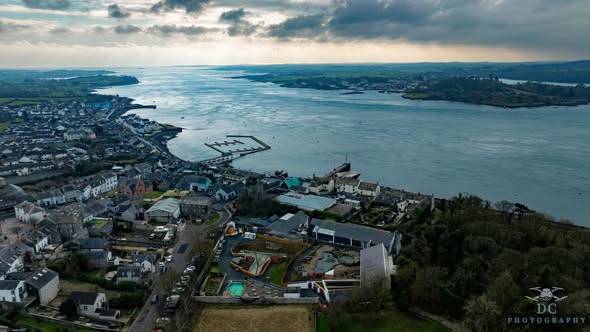
Strangford Lough runs north to south — broadly in the Belfast to Dublin direction. The Narrows crossing at its southern end spans east to west, linking Portaferry on the east shore to Strangford village on the west. That east-west bridge deck matters when you think about wind.
The prevailing wind across Northern Ireland blows from the south-west — roughly 60 to 70% of all winds come from that quarter. A south-westerly hitting an east-west bridge deck arrives at an oblique angle — partly along the deck, partly across it. That is a manageable, well-understood loading condition. It is not the worst-case scenario. It is the everyday one, and modern bridge engineering is built around handling it.
The genuinely dangerous winds for this particular crossing are strong northerlies or southerlies — those that track straight up or down the lough and strike the bridge deck at 90 degrees broadside. A powerful southerly coming up the Irish Sea through the mouth of the lough, funnelled and accelerated through the Narrows, is the scenario that deserves the most respect. Those events are relatively rare — but when they occur, the Narrows amplifies them. The catastrophic January 1974 storm produced a gust of 125 mph at Kilkeel, just down the coast — the highest ever recorded at sea level in Northern Ireland, and a direct consequence of that southerly funnel effect.
So the weather picture is: routine conditions are well-manageable, extreme events need engineering respect.
The Foyle Bridge — What It Tells Us
Foyle Bridge in Derry has a formal three-stage wind closure protocol, introduced after a lorry was blown off the bridge in January 2005, killing the driver. Since then:
- At 30 mph gusts — a speed limit advisory goes up
- At 40 mph — lorries and high-sided vehicles are redirected to Craigavon Bridge
- At 50 mph — the bridge closes to all traffic
That 50 mph threshold is crossed roughly 14 times a year on average — but most of those are hours, not whole days. The truly significant full-closure events over the last 50 years you could count on two hands: the Boxing Day Storm of 1998, the January 2005 fatality event, Storm Éowyn in January 2025, and Storm Amy in October 2025 — the most recent of which set a new October record of 92 mph at Magilligan, just up the coast from Derry.
Those were generational storms. In normal years, Foyle Bridge gets on with the job.
Strangford’s wind climate runs at a slightly lower annual mean than Foyle — around 10 mph compared to 11.5 mph at Magilligan. The peak gust record is higher, but that 1974 extreme is the outlier, not the daily reality. On a like-for-like basis, the SLC would face a broadly comparable wind regime to Foyle Bridge, with a different directional risk profile rather than a worse overall one.
There is one further important contrast. Foyle Bridge was built in 1984 with no wind closure protocol whatsoever. The monitoring system was bolted on twenty years later, after a fatality, at a cost of £800,000. It works — but it was reactive. A Strangford crossing designed today would have wind engineering built in from the very first drawing.
The Rose Kennedy Bridge — The Real-World Proof
In January 2020, Ireland opened the Rose Fitzgerald Kennedy Bridge near New Ross in County Wexford. At 887 metres it is the longest extradosed bridge in the world. It crosses the tidal River Barrow estuary in Atlantic weather conditions and carries the N25, a major national road.
The engineers didn’t leave wind to chance. Before design was finalised they built a full computer model of wind conditions at that specific site — simulating how air flows around the towers, along the deck, and across the lanes in different storm scenarios. Where the towers created local wind acceleration they fitted targeted wind barriers that reduce gust speeds by up to 50% in those zones. The deck cross-section was shaped to reduce aerodynamic loading. And since opening, live sensors continuously monitor forces, movements, and wind speeds on the structure in real time.
The result? No significant closures since it opened. In the worst storm of its first winter — Storm Bella in December 2020 — the maximum recorded sustained wind speed on the bridge was 53 mph. Uncomfortable, worthy of caution, but the bridge handled it.
Putting the Three Together
| Foyle Bridge | SLC / Strangford | Rose Kennedy | |
|---|---|---|---|
| Opened | 1984 | Proposed | 2020 |
| Wind engineering | Reactive — protocol added post-fatality 2005 | To be designed — site study required | Proactive — CFD, barriers, live monitoring from day one |
| Annual mean wind | ~11.5 mph | ~10.2 mph | ~11.0 mph |
| Worst recorded gust nearby | 92 mph (2025) | 125 mph Kilkeel (1974) | 53 mph sustained on bridge (2020) |
| Storm days >50 mph est. | ~14/yr | ~12/yr | ~8–10/yr |
| Closure record | Occasional — ~14 trigger events/yr, most hours not days | N/A | No significant closures |
The SLC sits between the two. Its wind climate is calmer than Foyle’s on average. Its extreme gust potential in southerly funnel events is real but rare. And the engineering toolkit available today — which the Rose Kennedy Bridge used to great effect — is far ahead of what existed when Foyle Bridge was built.
The Honest Bottom Line
The Strangford Lough Crossing would not face regular closures. The prevailing south-westerly wind meets the east-west deck at an oblique angle that is routine for modern bridge design. The more serious risk — strong northerly or southerly winds amplified through the Narrows funnel — is real, documented, and exactly what a site-specific wind study would characterise before a single design decision is made. The Rose Fitzgerald Kennedy Bridge, crossing a comparable Irish tidal estuary and opened just six years ago, has demonstrated that properly engineered long-span Irish bridges do not get closed all the time. The one thing the Narrows genuinely requires — which Foyle Bridge never had — is that wind study done upfront, as part of the feasibility process. That study is not a reason to delay the project. It is the project.
Supporting Data
A detailed wind exposure analysis covering the period 1976–2026 has been compiled in a downloadable Excel workbook — Wind Exposure Comparison: Foyle Bridge vs Strangford Lough Narrows vs Rose Kennedy Bridge. It includes annual wind speed data, monthly climatology, a full storm events log, and a three-way bridge comparison table with charts. The file is available to be downloaded directly from the link shared below.