- BY Kevin Barry BSc(Hons) MRICS
- POSTED IN Latest News
- WITH 0 COMMENTS
- PERMALINK
- STANDARD POST TYPE

Three Lough Ferries — What Population Does to Viability, and What That Means for Any Future Crossing
Published: May 2026 | Author: Kevin Barry BSc(Hons) MRICS | Category: Latest News
Northern Ireland is served by three lough ferry crossings: Strangford Lough, Carlingford Lough, and Lough Foyle. All three operate under broadly similar conditions — short sea crossings linking communities on either bank. Yet their commercial trajectories have diverged entirely. One is publicly subsidised and struggling. One has just collapsed. And one runs quietly, profitably and without a penny of public money.
The reason is not the water. It is the population on each bank.
This post examines each crossing in turn, sets out the verified traffic figures, and draws the inevitable conclusion for the Strangford Lough Crossing proposal.
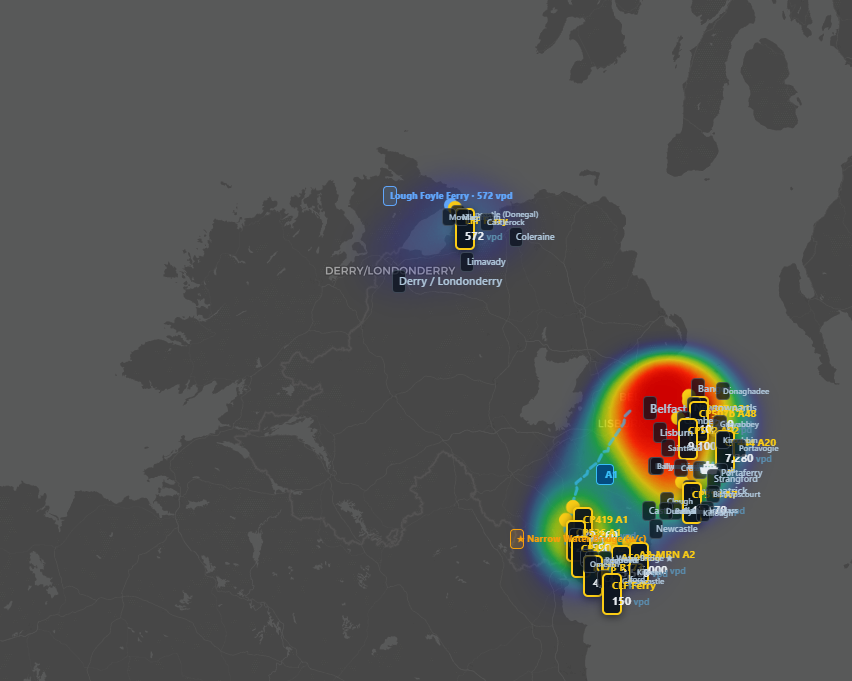
Click on image below for current heatmap, showing three ferry locations; Lough Foyle, Strangford Lough and Carlingford Lough
Strangford Lough Ferry — The Subsidised Crossing That Cannot Grow
The Strangford–Portaferry service is operated by the Department for Infrastructure on a year-round basis. The crossing is 800 metres and takes roughly eight minutes. It is the only fixed public transport link between the Ards Peninsula and the Lecale coast.
The population it serves is substantial. The Ards and North Down Borough Council area contains approximately 160,000 residents. Newtownards, the principal town, has a population of around 28,000. Bangor — connected to the peninsula corridor by the A21 — has 76,000. On the Lecale side, Downpatrick, Strangford, and the broader Newry, Mourne and Down District add a further 180,000+. The combined catchment accessible via a fixed crossing at the Strangford Narrows exceeds 300,000 people.
And yet the ferry carries just 650 vehicles per day (DfI FOI ref. DFI-2024-0412, Mark McPeak, 7 August 2024).
That figure represents 83% avoidance. Drivers who could use the ferry are instead travelling up to 30 additional miles via Downpatrick or Comber. The A21 Newtownards corridor registers 21,200 vpd (CP507, DfI Traffic Census 2023) — one of the most congested in the area. The A22 round-lough route records 9,100 vpd (CP512, DfI 2023). The ferry, despite sitting between these flows, captures a fraction of them.
Why? Because the ferry format is structurally unsuited to its catchment. The vessel capacity, wait times, operating hours, and cost structure of a small cable ferry cannot serve a 300,000-population corridor. Drivers are not irrational — they are correctly calculating that the ferry is slower, less reliable, and more costly than the A21 for most journeys.
The result is that DfI funds a service carrying 650 vpd at an annual cost exceeding £1 million in public subsidy — while the suppressed demand it cannot capture sits idle on the roads around the lough.
Carlingford Lough Ferry — The Commercial Collapse
The Carlingford service — operated by Frazer Ferries, the same operator that runs Lough Foyle — connected Greencastle in Co. Down with Greenore in Co. Louth. The crossing was approximately 2.60 kilometres, in approx 15-20min.
In 2026, the service was suspended. Frazer Ferries cited unsustainable passenger numbers. No public subsidy was available and none was sought. The service had been marketed primarily as a tourist and leisure crossing.
The fundamental reason is geography and population. Greencastle (Co. Down) is a small coastal village. Greenore (Co. Louth) is a small harbour village. There is no major population centre on either bank. Newry, the nearest city, is accessible by road but the crossing does not materially reduce journey times for Newry residents travelling into Louth — the road via Newry city is the natural corridor regardless.
Estimated demand at time of suspension was approximately 150 vpd — a figure derived from comparable Frazer Ferries operational data and the 2026 suspension announcement. No DfI permanent counter exists at this location and no published figure has been issued by the operator.
At 150 vpd, the commercial arithmetic is straightforward: there is no recovery. A ferry operation at that scale cannot cover vessel maintenance, crewing, fuel, berthing, and insurance without either a significant increase in passenger numbers or public subsidy. Neither was forthcoming.
The lesson of Carlingford is not that lough crossings cannot work. It is that they cannot work without a population catchment large enough to generate year-round demand. Tourism alone — seasonal, weather-dependent, and price-sensitive — cannot sustain a commercial ferry service.
Lough Foyle Ferry — The Viable Exception
The Lough Foyle service, operated by Frazer Ferries between Greencastle (Co. Donegal) and Magilligan (Co. Derry/Londonderry), is the only one of the three crossings that is commercially self-sustaining. It operates on a seasonal basis, typically May to September.
In 2025, the service made 39,734 crossings carrying 208,823 motor vehicles — equivalent to 572 vpd across the operating season (Frazer Ferries / 27News, Facebook, March 2026).
That is a lower raw vpd figure than Strangford (650) and dramatically below what a fixed crossing at Strangford would generate. So why is Lough Foyle commercially viable when Strangford is not?
The answer is purpose and scale. Lough Foyle is a seasonal tourist crossing. It saves approximately 1.5 hours of driving around the lough for visitors travelling between the Inishowen Peninsula and Derry/Londonderry or the Causeway Coast. The passenger profile is overwhelmingly leisure: holidaymakers, day-trippers, coastal tourism traffic. The service operates only when that market is active. When the season ends, the costs stop.
There is no year-round commuter base on either bank of Lough Foyle at the crossing point. Magilligan is a small coastal settlement. Greencastle (Donegal) is a small fishing village. The Inishowen Peninsula has a dispersed rural population. Derry city — the major population centre — is already on the Derry side of the crossing and does not depend on the ferry for daily movement.
The Lough Foyle model works precisely because it is not trying to be something it is not. It is a leisure crossing, operating seasonally, calibrated to a specific tourist demand. It makes no attempt to serve a commuter corridor, because there is no commuter corridor to serve.
The Comparison That Matters
| Ferry | Banks | Key settlement | Est. vpd | Subsidy | Status |
|---|---|---|---|---|---|
| Strangford | Portaferry / Strangford | Newtownards (28k), Bangor (76k), Downpatrick | 650 | £1M+/yr public | Year-round, publicly subsidised |
| Lough Foyle | Greencastle (Don.) / Magilligan | Inishowen tourism | 572 | None | Seasonal, commercially viable |
| Carlingford | Greencastle (Down) / Greenore | No major centre | ~150 | None | Suspended 2026 |
The pattern is unambiguous. Commercial viability tracks population and purpose, not crossing length or water conditions. Where there is no population, there is no commercial ferry. Where there is population but the wrong format, there is a subsidised ferry. Where there is a specific, bounded, seasonal use case, there is a viable private ferry.
What This Means for the Narrow Water Bridge
The Narrow Water Bridge is under construction between the A2 roundabout south of Warrenpoint and the R173 roundabout at Omeath. The 195-metre cable-stayed bridge, funded by the Shared Island Fund and being built by BAM Ireland, is projected to open in 2028.
The traffic projection accepted by planning authorities was 2,227 vpd (Louth County Council Environmental Impact Statement, 2012, Table 3 — mean case). The A2 Warrenpoint corridor currently carries 14,750 vpd (CP421, DfI Traffic Census 2023). The R173 at Omeath registers an estimated 4,421 vpd (EIS 2012 base year).
A bridge generating 2,227 vpd has been approved, funded, and is being built.
The Strangford Lough Crossing central case projects 14,100 vpd by Year 5 — more than six times the Narrow Water threshold. The TEE-only break-even for SLC at £625m adjusted capex is 285 vpd — the ferry today already carries more than twice that. The full Green Book break-even is approximately 5,000 vpd, well within the central forecast range.
Narrow Water Bridge was justified at 2,227 vpd. No one argued it was unviable because of that figure. The same standard should apply at Strangford.
The Population Argument — and the Commercial Failure at Carlingford
The Carlingford suspension is instructive for a specific reason. It confirms that the private sector, left to assess the commercial merits of a lough crossing, will not invest where there is insufficient population. Frazer Ferries did not ask for subsidy. They withdrew.
At Strangford, the opposite conditions exist. The population catchment — over 300,000 — is among the largest of any comparable crossing point in the UK and Ireland. The suppressed demand is documented. The 83% avoidance rate is not a sign that people do not want to cross; it is a sign that the current crossing format is inadequate for the catchment it serves.
A fixed crossing would not replace the ferry. It would unlock the demand the ferry cannot carry.
The commercial failure of Carlingford at 150 vpd with a small-village catchment, the seasonal viability of Lough Foyle at 572 vpd with a tourist catchment, and the structural inadequacy of Strangford at 650 vpd despite a 300,000-population catchment — these are not three unrelated stories. They are the same story told three times.
Population determines viability. Strangford Lough has the population on both sides. It does not have the infrastructure.
Sources and Methodology
- DfI Traffic Census 2023, OpenDataNI — CP421, CP507, CP512 (verified AADT figures)
- DfI FOI ref. DFI-2024-0412 (Mark McPeak, 7 August 2024) — Strangford ferry 650 vpd
- Frazer Ferries / 27News Facebook (March 2026) — Lough Foyle 208,823 vehicles in 2025
- Louth County Council, Narrow Water Bridge Environmental Impact Statement (2012), Table 3 — 2,227 vpd projected
- Quintin QS, TAG-Compliant Economic Appraisal, March 2026 — BCR and NPV figures
- Minister Kimmins, NI Assembly, 11 May 2026 — “in excess of £500M” capital cost reference
- Carlingford vpd (~150) is an ESTIMATED figure — no DfI permanent counter exists and no published figure has been issued by the operator
All figures marked ESTIMATED or PROJECTED are labelled as such in the SLC interactive heatmap. DfI permanent counter figures are sourced directly from OpenDataNI and are not estimated.
Kevin Barry BSc(Hons) MRICS
Quintin QS | strangfordloughcrossing.org | quintinqs.com
The interactive traffic heatmap is available at the image link above. The TAG-compliant feasibility appraisal is published in full at quintinqs.com/full-tag-compliant-economic-appraisal-march-2026.