
- BY Kevin Barry BSc(Hons) MRICS
- POSTED IN Latest News
- WITH 0 COMMENTS
- PERMALINK
- STANDARD POST TYPE
The Ferry, the Timetable and the 75 km Detour

What is happening to the Strangford ferry, who is using it, and what everyone else is doing instead.
Ask any low-cost airline three questions about a route: how old is the aircraft, how full is it, and what are the customers who didn’t fly doing instead? The Department for Infrastructure (DfI) has answered the first in part, and has told us in writing that it holds nothing that answers the second or the third.
The ferry
MV Portaferry II, one of the two vessels on the crossing, was built in 2001, according to its Maritime and Coastguard Agency certificate. It is certified for 260 passengers (Passenger Ship Safety Certificates, Annex A to DfI response DFI/2026-0415, 5 August 2026).
This is not the first time the Department has had to think about an ageing ferry. In 2010 the then Roads Service commissioned marine consultants, who reported that the 1969-built MV Strangford should not run beyond 2016 (Strangford Lough Ferry Service Strategic Review Report, 22 March 2013, pp. 10 and 37). A £6.2 million replacement followed (DfI, “New Strangford Ferry begins service”). For MV Portaferry II, now 25 years old, we asked the same questions in 2026. DfI’s answers:
- no internal assessment of the remaining economic life of either vessel;
- no recorded information on replacement planning;
- no recorded information on which appraisal framework would govern a replacement decision; and
- no recorded information on whether a fixed crossing is an option to assess or exclude (DFI/2026-0415, items 1(b), 2(a) to 2(d) and 3(a) to 3(c)).
The service moved to a new directorate on 1 April 2023. Asked for Ministerial submissions, DfI replied that the “Northern Ireland Executive was not functioning at this time”. It held no information on the appraisal and value-for-money requirements for replacement, continuation or a fixed link (DfI response DFI/2026-0357, “Strangford Lough Ferry Service Reclassification”, 6 July 2026, items 2(b) and 5(c)). Asked for any business case or assessment of the transfer, it pointed to Annex A, an email chain of February 2023 about staffing and the transfer date (DFI/2026-0357, item 3(a) and Annex A).
The second ferry
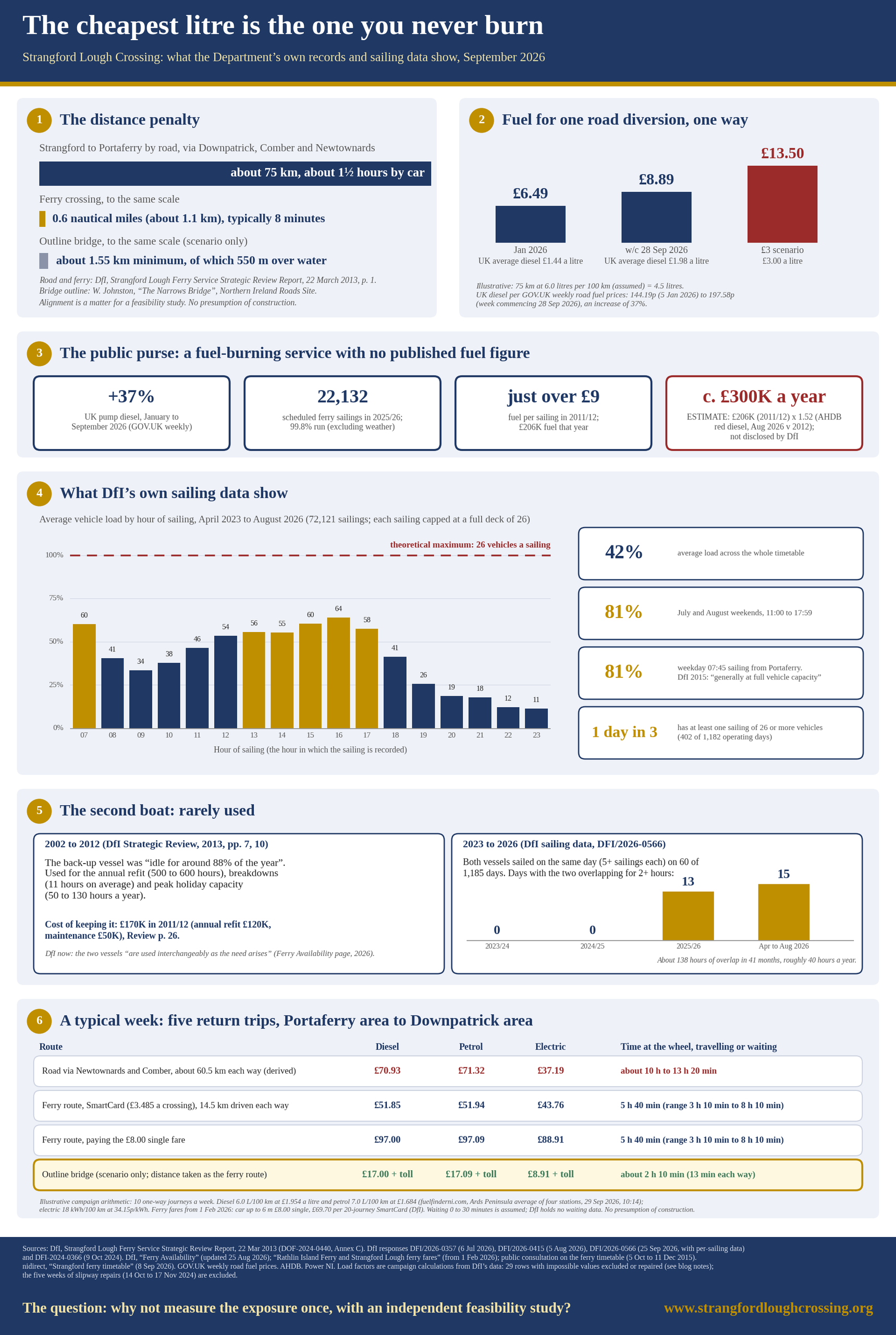
The Department’s 2013 Strategic Review said the older back-up vessel was “idle for around 88% of the year”. It was used for the annual refit (500 to 600 hours), for breakdowns (11 hours on average) and for holiday peaks (50 to 130 hours a year). Keeping it cost £170,000 in 2011/12 (Review, pp. 10 and 26).
The pattern has not changed much. Across 1,185 operating days from April 2023, only one vessel sailed on about 95% of them. On 60 days both sailed, but 32 of those were handovers. The two ran side by side for two hours or more on only 28 days: none in 2023/24 or 2024/25, 13 in 2025/26 and 15 in April to August 2026. That is roughly 40 hours a year (campaign calculation from DfI response DFI/2026-0566). DfI says the two vessels “are used interchangeably as the need arises” (DfI, “Ferry Availability”, 2026). Each vanishes from the sailing record for weeks at a time, and the record does not say why.
The usage
On 25 September 2026, DfI released a count of vehicles and passengers on every sailing from April 2023 to August 2026 (DfI response DFI/2026-0566, “Details relating to the operating capacity of the Strangford Ferry service”, 25 September 2026, with attachment). We analysed roughly 73,500 rows.
- Flat. The ferry carried about 650 vehicles a day in each of 2023/24, 2024/25 and 2025/26 (648.1, 647.5 and 650.0).
- Reliable. DfI scheduled 22,132 sailings in 2025/26 and ran 99.8% of them, excluding weather (DfI, “Ferry Availability”). The boat sails. The question is what it can carry.
- Full when it matters. In 2015 the Department’s predecessor recorded that the first weekday sailing from Portaferry, at 7.45am, “is generally at full vehicle capacity” (TransportNI, public consultation on the ferry timetable, 5 October to 11 December 2015). Today’s data has that slot averaging about 81% of a 26-car deck. On July and August weekends between 11:00 and 17:59, the average is also about 81%. On 402 of 1,182 operating days, at least one sailing carried 26 or more vehicles.
- Empty when it doesn’t. Over the whole timetable the average load is 42%. Sailings from 19:00 onwards run at between 11% and 26%.
- Five weeks with no vehicle ferry. From 14 October to 17 November 2024, the vehicle ferry was suspended for slipway repairs and a passenger-only vessel ran instead. DfI told drivers to use “the alternative route via Newtownards” (DfI announcement, 16 September 2024). What that did to traffic on the roads round the lough is the obvious next question for DfI.
DfI’s position, in its letter TOF-0624-2026, is that the ferry “is not understood to be operating at capacity”. Asked for the evidence, DfI said observational evidence supports this. It holds no formal document, study, analysis or internal assessment on capacity, no load-factor or utilisation analysis, and no record of sailings cancelled, delayed or curtailed because the vessel was full. It has never commissioned a capacity or demand assessment (DFI/2026-0566, items 1, 4, 5 and 7). The statement was approved by Ian McClung, Head of Consultancy Services (item 6).
These are our calculations from DfI’s data. Our count of recorded sailings is within 2.3% of the Department’s own published count of scheduled sailings less missed ones (30,100 against 29,428, April 2025 to July 2026). The calculations exclude the five weeks of slipway repairs, and 16 rows that record between 51 and 96 vehicles on a single sailing, which a deck of 24 to 26 cannot hold. A further 13 rows carry an extra digit (for example 325 vehicles); for those we used the first two digits, a campaign treatment DfI has not confirmed. Excluding all 29 rows instead makes no material difference. Each sailing is capped at a full deck of 26. The rows are listed in a schedule available on request.
What people are doing
This is where it gets interesting, because nobody official is counting.
When the boat is full, has stopped for the night, or is not running, the alternative from Strangford to Portaferry is about 75 km by road, via Downpatrick, Comber and Newtownards: “about an hour and a half by car”, according to the Department’s own Review (p. 1). One such diversion burns about 4.5 litres of diesel. UK diesel has risen 37% this year, from 144p a litre on 5 January to 198p in the week beginning 28 September (GOV.UK weekly road fuel prices).
Take a typical week: five return trips between the Portaferry and Downpatrick areas, ten one-way journeys.
| Route | Weekly cost (diesel, plus ferry fares where used) | Weekly time |
|---|---|---|
| By road via Newtownards and Comber, about 60.5 km each way | £70.93 | about 10 h to 13 h 20 min |
| Via the ferry, SmartCard fare of £3.485 a crossing | £51.85 | about 5 h 40 min |
| Via the ferry, paying the £8.00 single fare | £97.00 | about 5 h 40 min |
Illustrative campaign arithmetic: diesel at 6.0 litres per 100 km and £1.954 a litre (fuelfinderni.com, Ards Peninsula average of four stations, 29 September 2026, 10:14); car fares from 1 February 2026 (DfI, “Rathlin Island Ferry and Strangford Lough ferry fares”). Waiting time is assumed at 0 to 30 minutes, with 15 on average; DfI holds no waiting data.
So the ferry is cheaper than the long way round only for regular users on the SmartCard, and it is quicker for everyone: at least 4 h 20 min a week. Fares rose from November 2009 levels by about 40% for a single adult journey and 38% for a car (DfI, 29 November 2023 and 1 February 2026). Vehicles carried did not fall. The people in the road row are the ones the count misses: those who drove round, drove somewhere else, or stayed at home. Some survey respondents describe exactly that (Survey for Strangford Lough Alternative Crossing, Rev 0, September 2024; self-selecting community testimony, not a statistical sample).
The ferry burns fuel too, and no current figure is published. The last one we hold is £206,000 for 2011/12, or just over £9 a sailing (Review, p. 26). Scaled by the AHDB diesel index, our estimate is about £300,000 a year now. That is an estimate. DfI has not disclosed the real number.
What nobody knows
Put the letters together and the shape is plain:
- how much life is left in the boat: not assessed;
- what replaces it: no plan recorded;
- whether a fixed crossing is even an option: no record;
- how full the ferry is when it matters: not measured;
- how many trips are never made, or made the long way round: not counted.
None of this is an argument that a bridge is justified. It is an argument that nobody can say either way. The ferry counts the people who got on the boat. The people who didn’t never appear.
The ask
We are not asking for a bridge. We are asking for an independent feasibility study, with no presumption of construction, to replace observation with evidence. Specialist industry advice puts the cost at £250,000 to £500,000. The ferry costs the taxpayer a net £2,090,000 a year (DfI response DFI-2024-0366, 9 October 2024). The study would cost roughly six to twelve weeks of that annual subsidy, once.
The Minister told the Assembly on 3 February 2026, “why not? I am happy to keep that under review” (Hansard, Northern Ireland Assembly, Vol. 188, No. 2, 3 February 2026). We agree. Why not measure it once, and properly?
Read the correspondence, the data and the analysis at www.strangfordloughcrossing.org.
Sources
- Department for Infrastructure, responses DFI/2026-0357 (6 July 2026), DFI/2026-0415 with Annex A (5 August 2026) and DFI/2026-0566 with per-sailing attachment (Daniel Healy, 25 September 2026); DFI-2024-0366 (9 October 2024); TOF-0624-2026 (Ian McClung, 28 August 2026)
- Strangford Lough Ferry Service Strategic Review Report, 22 March 2013 (DOF-2024-0440, Annex C)
- DfI, “Ferry Availability” (updated 25 August 2026); “Rathlin Island Ferry and Strangford Lough ferry fares” (from 1 February 2026); “New Strangford Ferry begins service”; announcements of 16 September 2024, 7 October 2024 and 29 November 2023
- nidirect, “Strangford ferry timetable” (updated 8 September 2026)
- TransportNI, public consultation on a proposed amendment to the Strangford Lough ferry timetable (5 October to 11 December 2015)
- Hansard, Northern Ireland Assembly, Vol. 188, No. 2, 3 February 2026
- Survey for Strangford Lough Alternative Crossing (Rev 0), September 2024
- GOV.UK weekly road fuel prices (via PetrolPal and IndexBox reports); fuelfinderni.com (29 September 2026); AHDB