
- BY Kevin Barry BSc(Hons) MRICS
- POSTED IN Latest News
- WITH 0 COMMENTS
- PERMALINK
- STANDARD POST TYPE

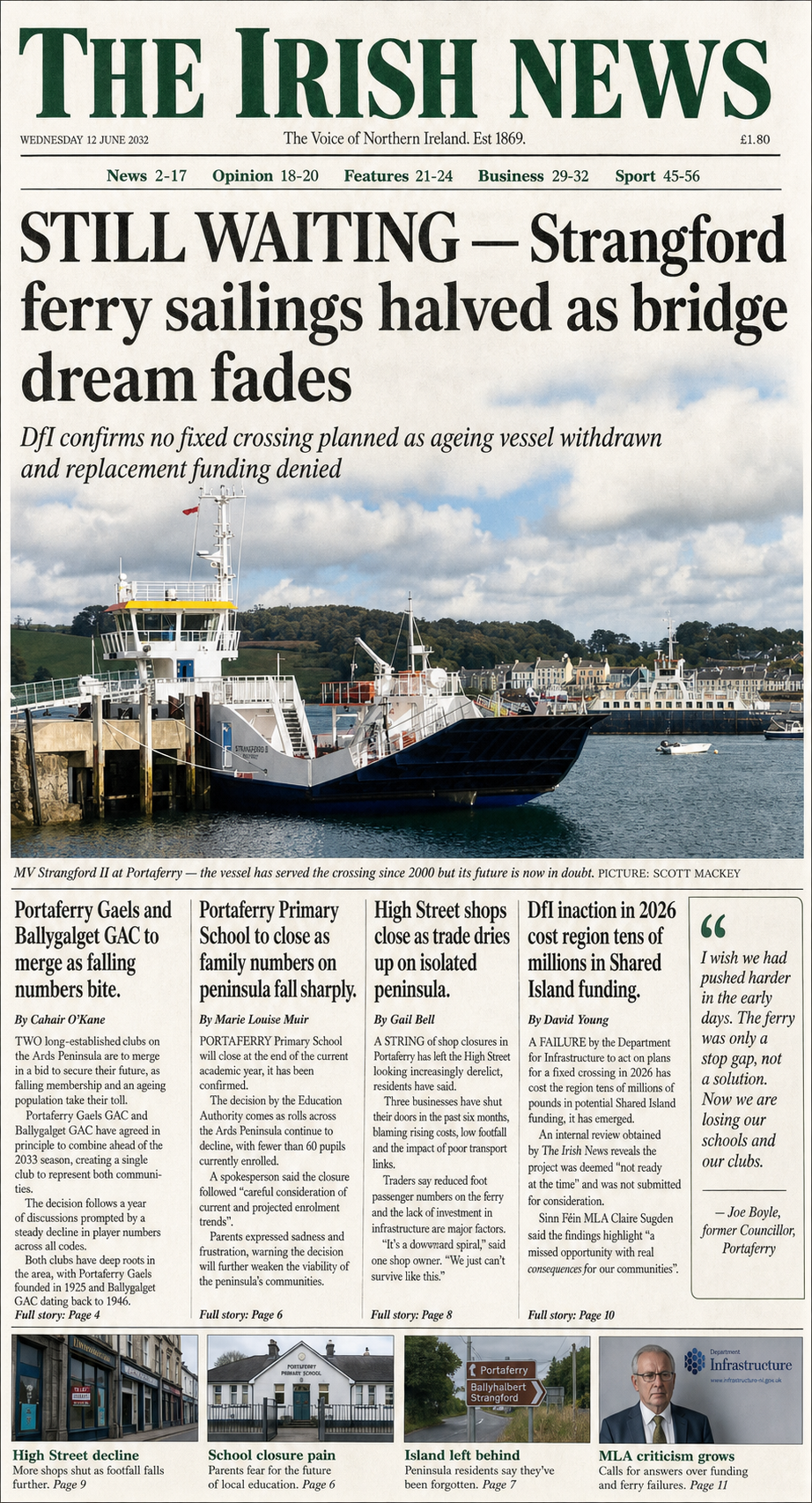
An AI generated look into the future !
The Ards Peninsula: A Case File On Managed Decline
For over sixty years the Strangford Lough question has been framed the same way: can we justify a fixed crossing?
The wrong question.
The correct question :
What is the running cost of doing nothing, and who is paying it?
What follows is not advocacy. It is a case file. Each exhibit is drawn from public record, departmental data, or published comparator evidence. The reader is invited to weigh the exhibits and reach their own verdict.
Exhibit A — The asset itself
The Strangford ferry is operated by the Department for Infrastructure using two ro-ro vessels, MV Strangford II and MV Portaferry II, on an eight-minute crossing between Strangford and Portaferry. Service runs roughly fifteen hours per day, 364 days a year (Department for Infrastructure).
DfI’s own annual return shows that in 2024 the service moved 237,250 vehicles — approximately 33.9% of its theoretical maximum capacity. Over the last twenty-five years the average has hovered around 30% (Quintin QS analysis of DfI figures).
The financial position published in DfI’s own response (DFI 2024-0366) is equally specific:
- Annual operating cost: £3.52m
- Annual income: £1.43m
- Cost recovery: 41%
- Net annual subsidy: £2.09m
This is not, in any reasonable interpretation, a service operating near its limit. It is a constrained service whose usage has been capped by reliability, hours of operation, weather, and crewing rather than by demand.
Exhibit B — The maintenance ledger
DfI’s evidence to the Northern Ireland Assembly’s Committee for Infrastructure on 11 June 2025 set out the structural maintenance position in plain terms: the assessed annual need is approximately £194 million; the indicative opening allocation for 2025-26 is £68 million. Departmental officials confirmed that a “limited service” standard has been in operation since 2014 and that restoration of normal service is no longer considered achievable (NI Assembly Committee for Infrastructure, 11 June 2025).
The NI Audit Office has separately estimated the cost of clearing the existing road maintenance backlog at £1.2 billion (Assembly Research Matters).
That same research paper identifies the Ards Peninsula coastline by name as among the areas where rising sea levels threaten transport infrastructure by 2050.
This is the budgetary environment in which the Strangford crossing question sits. It is not a hypothetical squeeze. It is a documented, multi-year, structural shortfall.
Exhibit C — The 2024 suspension
On 14 October 2024 the Strangford ferry was suspended for five weeks to allow essential health and safety work at both slipways. The mitigation arrangements published by the Department are revealing in themselves (DfI press release):
- A bus substitution specifically for Assumption Grammar School pupils
- A reduced passenger-only ferry with a last sailing of 18:45
A single planned closure required the standing-up of a bespoke schools service and the truncation of the evening crossing window by nearly four hours. The contingency is not a marginal arrangement; it is the visible architecture of dependence.
Exhibit D — The witnesses already on record
Campaign own consultation responses record 94% dissatisfaction with current service capacity (Quintin QS).
The community transport sector, giving oral evidence to the same Assembly Committee in May 2025, described “unstable funding, recruitment and retention challenges, ageing fleets and rising costs” and stated explicitly that “service delivery is based on available budgets rather than need” (Committee for Infrastructure, 21 May 2025).
The Countryside Alliance, in April 2026, observed that rural Northern Ireland “experience[s] the consequences of wider housing demand, but without the same level of infrastructure investment or strategic attention given to urban growth zones” (Countryside Alliance).
NISRA’s 2022-based projections, and BBC reporting in April 2026, confirm that Northern Ireland’s population is ageing rapidly (BBC News; NISRA).
None of these witnesses are partisan. They are describing the same operating environment from different angles.
Exhibit E — The comparator evidence
This is the part of the file most often left out of the local debate.
Skye Bridge (Scotland, 1995). Evaluation work commissioned by HITRANS attributed approximately 256 full-time-equivalent jobs and £4.67m of additional income to the fixed link, equivalent to 6.3% workforce growth in the affected area (HITRANS / Napier University).
Eysturoy Tunnel (Faroe Islands, 2020). Replaced a 64-minute drive with a 16-minute drive. House prices on the Eysturoy side rose 31% in the first year and had already doubled over the preceding five (Wikipedia / Eysturoyartunnilin).
Sandoy Tunnel (Faroe Islands, 2023). The southern island of Sandoy had experienced five to six decades of population decline before the tunnel opened. The local population has since stabilised and begun to grow, and house demand has materially increased (BBC documentary).
Shetland (Scotland, 2025). Shetland Islands Council has commissioned a £990,000 feasibility study for a fixed-link tunnel network, explicitly modelled on the Faroese approach of borrowing against tolls. The council leader’s stated reason is that Scottish salmon’s share of the global market has halved — from 10% to approximately 5% — and infrastructure under-investment is named as a contributing factor (BBC News, July 2025).
These cases share one feature: the modelled pre-construction transport demand consistently underestimated the actual post-construction demand, because the constrained service was suppressing trips that the open service then unlocked.
Applied to Strangford, the relevance is direct. A service running at 34% of theoretical capacity, with 94% user dissatisfaction, in an area where the catchment populations of Ards & North Down (163,659) and Newry, Mourne & Down (182,074) currently undertake very limited cross-lough commuting, is by definition a suppressed market.
The argument from the ledger
Set the exhibits side by side.
A subsidised service, structurally capped at a third of its theoretical capacity, in a Department whose structural maintenance budget is funded at roughly 35% of assessed need, in a region whose population is ageing, in a coastal area flagged for sea-level exposure, with comparator evidence from three jurisdictions showing that fixed crossings in similar geographies have unlocked measurable demographic and economic recovery.
The standard objection to a Strangford fixed link has been: the economic case does not currently justify the investment. That sentence is doing a great deal of work. It is comparing the cost of action against an assumed baseline in which the do-nothing scenario is free, static, and consequence-neutral.
It is none of those things.
The do-nothing scenario carries:
- £2.09m of recurring annual subsidy with no path to cost recovery
- A structural maintenance environment that the Department itself describes as no longer capable of restoring normal service
- An asset base exposed to coastal climate risk that is, on the Audit Office’s own assessment, already £1.2bn behind on maintenance
- Demographic drift that comparator evidence suggests is at least partly causally linked to transport accessibility
- Foregone induced demand of the order demonstrated at Skye, Eysturoy and Sandoy
Exhibit F — The 1969 baseline
The MV Strangford was launched on 6 September 1969 at the Verolme Shipyard in Cork, the year Down District Council took over operation of the first vehicle-carrying ferry across the Narrows (Wikipedia / Portaferry–Strangford ferry; NI Ferry Site). Even earlier, in 1959, discussions were taking place about a permanent crossing.
That is the baseline.
Fifty-seven years. Two replacement vessels. The same eight-minute crossing. The same 47-mile alternative road route. The same operating window. The same structural dependency.
Measure the Peninsula against that 1969 baseline on any single metric — relative population growth versus the rest of Northern Ireland, share of working-age residents, business formation rates, average commute resilience, healthcare access times following hospital centralisation, school transport contingency — and the trajectory is not one a serving councillor or a sitting representative should be comfortable defending.
This decay did not happen in one term of office. It happened across decades of councillors, business leaders, and political representatives who individually meant no harm and collectively presided over a measurable downward drift in the relative standing of the Ards Peninsula. The phrase managed decline is not used here as an insult. It is used as a description of what the public record actually shows. Ards Peninsula Demographics (1971-2021) (supporting evidence)
Those who held positions of influence during that period — at council, at chamber, at constituency level — are entitled to a reply. They should be expected to provide one.
The civic deadline: May 2027
Northern Ireland’s next local government elections are due in May 2027. That is the next opportunity at which the people of the Ards Peninsula — every household, every business, every school, every GP practice, every farmer, every employer, every haulier, every tourism operator — get to weigh in on whether the trajectory described above is acceptable.
This is not a question for a campaign group to answer on behalf of the Peninsula. It is a question for the Peninsula itself.
The local business community in particular has been conspicuously quiet, resigned to nothing changing but supportive out of courtesy, daring not to hope.
Hauliers absorbing diversion mileage, tradesmen absorbing lost half-days, retailers absorbing reduced footfall on cancelled-ferry days, hospitality operators absorbing the cost of unreliable customer access — each of these is a measurable commercial cost, and each is currently being absorbed in silence. Silence is read by decision-makers as consent. It should not be.
Before May 2027, the Peninsula needs to do three things on the public record:
- State the cost. Every business, sector body, and community group with a quantifiable cost of the current arrangement should publish it. Not opinions — numbers.
- Ask candidates for a position. Every candidate seeking election in May 2027 should be asked, on the record, whether they accept the trajectory documented in Exhibits A through F, and what they intend to do about it.
- Refuse the default. The do-nothing option has been the default for 57 years precisely because it has never been openly chosen — only allowed to continue by absence of challenge.
An AI generated look into the future !
The verdict the reader is asked to consider
The case file does not, on its own, prove that a fixed crossing is the right answer. It establishes something narrower, and harder to dismiss: doing nothing is not free, and it has not been free for 57 years. Every year the Peninsula pays — in subsidy, in lost trade, in cancelled crossings, in young people who left, in businesses that invested somewhere easier. That bill is real. It has simply never appeared on a ballot paper.
Ahead of May 2027, every party manifesto issued in this constituency should be read against the exhibits in this file. Each party — DUP, Sinn Féin, UUP, SDLP, Alliance, TUV, Greens, and any independent standing — should be expected to state, in writing and on the record, its position on the Strangford crossing, on the £194m-versus-£68m structural maintenance gap, on the £2.09m recurring ferry subsidy, and on the demographic trajectory of the Ards Peninsula.
Manifestos that are silent on these questions should be treated as silent by choice, and scrutinised accordingly at the doorstep, at hustings, and at the ballot box. In May 2027, the Peninsula decides whether it accepts the bill, or sends it back.
Ards Peninsula Demographics (1971-2021) (supporting evidence)
Sources
- DfI Ferry Availability data
- DfI Strangford ferry suspension notice, October 2024
- NI Assembly Committee for Infrastructure, 11 June 2025
- NI Assembly Committee for Infrastructure, 21 May 2025
- Assembly Research Matters — climate risks to NI transport
- DfI Draft Budget 2025-26 EQIA Consultation
- BBC: NI’s ageing population
- Countryside Alliance: rural NI
- HITRANS Skye Bridge evaluation
- Eysturoy Tunnel — Wikipedia
- BBC: Shetland tunnel feasibility
- Faroe Islands tunnels documentary
- Quintin QS — Strangford ferry capacity analysis
- Portaferry–Strangford ferry history (Wikipedia)
- NI Ferry Site — MV Strangford vessel profile