
- BY Kevin Barry BSc(Hons) MRICS
- POSTED IN Latest News
- WITH 0 COMMENTS
- PERMALINK
- STANDARD POST TYPE
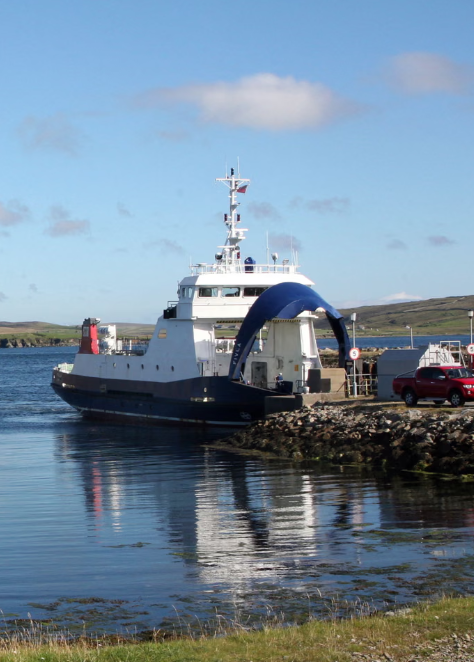
Shetland Digs In. Strangford Still Waits for a Study.
How a £1.5 billion island tunnel programme exposes the £250,000 question Stormont will not answer
Strangford Lough Crossing Campaign | www.strangfordloughcrossing.org
On Tuesday 30 June 2026, Shetland Islands Council was expected to back a draft strategy for one of the most ambitious fixed-link programmes in these islands: a network of undersea tunnels to replace its inter-island ferries, with a headline figure reported at around £1.5 billion (Press Association wire, 30 June 2026).
For anyone who has followed the Strangford Lough Crossing Campaign, the Shetland story is worth a careful read. Not because Strangford should copy Shetland’s engineering. It should not. Shetland is drilling through deep North Atlantic sounds, some of them up to 80 metres below sea level (Network Strategy Strategic Outline Case, Stantec / COWI / Mott MacDonald / ProVersa, July 2025). The crossing between Portaferry and Strangford is a short, sheltered span at the Narrows. The campaign’s proposition is, and remains, a fixed bridge.
The story matters for a different reason. Shetland shows what a public authority does when it actually wants to know the answer.
1. Shetland paid to find out. DfI refuses to look.
Shetland Islands Council did not wait for certainty to fall from the sky. It commissioned the work. The council confirmed to the UK Parliament’s Scottish Affairs Committee that it expected to have spent close to £2 million on study work by the time its Outline Business Case reaches members (Shetland News, 15 May 2026). On 25 June 2025 councillors approved a further sum of up to £990,000 for a Fixed Link Model study to test commercial and financial viability (Ground Engineering, 4 July 2025). Community groups on Yell and Unst went further still, funding their own geological and sonar surveys (The Week, 20 March 2026).
Now set that against Strangford. The campaign’s singular ask is modest by any measure: an independent, TAG-compliant feasibility study, estimated by specialist industry advisers at £250,000 to £500,000 depending on scope. There is no presumption of construction. The study would simply establish whether a case exists.
DfI’s recorded position has been to decline. The reasoning was set out, in the Department’s own hand, in the internal memorandum released under Freedom of Information reference DFI-2024-0412 (M. McPeak, 22 August 2024, cleared by D. Porter, 30 August 2024). That memorandum recommended against commissioning a study on the grounds that it would give “false hope to elected representatives.” Read that again. The objection to finding out was that finding out might raise expectations.
Shetland spent nearly £2 million to replace false hope with evidence. Strangford has been refused £250,000 to do the same thing.
2. The finding Shetland’s numbers actually deliver
According to whole-life cost estimates published by the council’s consultants and reported by the Shetland Times (29 May 2026), building and operating the four tunnels over a 60-year period was estimated to exceed £1.6 billion. That sounds enormous. But the same exercise put the cost of simply maintaining the existing ferry service, the “do nothing” option, at around £1.77 billion over the same period, roughly £168 million more than the tunnels. A more ambitious “do max” ferry scenario was estimated to exceed £3.4 billion (Shetland Times, 29 May 2026; figures stated to exclude contingency).
In plain terms: the fixed link was found to be cheaper than carrying on as we are.
This is precisely the question the Strangford ferry subsidy raises and never gets to answer. The net annual subsidy for the Strangford service is confirmed at £2,090,000 (FOI reference DFI-2024-0366). Project that forward across the design life of a permanent structure and the “do nothing” bill is not small. It is simply unexamined, because the appraisal that would examine it has been refused.
You cannot claim a fixed link fails on value for money while refusing to commission the appraisal that would test value for money. Shetland did the appraisal. Strangford has been denied it.
3. Faroe for Shetland. Cleddau for Strangford.
Shetland did not pick its comparator at random. The council points repeatedly to the Faroe Islands, where a tunnel network built between 2002 and 2022 has been credited with cutting journey times by up to 80 per cent and contributing to net immigration over the past decade (The Week, 20 March 2026). Council leader Emma Macdonald put the principle directly: islands that gain fixed links experience repopulation, economic growth and a fall in average age (Shetland Islands Council, May 2026).
The campaign has been making exactly this argument with exactly this kind of evidence, only ours is closer to home and even more pointed.
When Wales replaced the Cleddau ferry with a permanent bridge in 1975, the redundant vessel was relocated to Strangford, where it became the MV Portaferry. The two crossings then ran a 50-year live experiment. Cleddau, with its fixed link, grew from roughly 885,900 crossings in 1975 to approximately 4,745,000 in 2024, a near twenty-fold increase. The Strangford ferry, with no fixed link, has shown effectively no growth across the same half-century.
Shetland looks to the Faroes for proof that fixed links release latent demand. Strangford already owns the proof, and it sailed here from Wales.
4. The O’Leary lens: the cheapest thing you can buy is the truth
It is worth viewing all of this through the discipline Michael O’Leary built Ryanair on. Not the showmanship, the discipline. Ryanair’s central insight was that the cost structures and assumptions the aviation establishment treated as fixed facts were nothing of the sort. The incumbents said it could not be done cheaper. O’Leary refused to accept the assertion and demanded the numbers.
DfI has issued assertions about Strangford. It has not issued a study. In the Assembly Chamber on 3 February 2026, the Minister described the cost of a crossing as “in and around £300m” (Official Report, Volume 188, No. 2, 3 February 2026). By 11 May 2026, in answer to an oral question, the figure had moved to “in excess of £500m” (AQO 3527/22-27, 11 May 2026). No study was commissioned between those two dates. The number rose by over £200 million on the strength of nothing.
The Department’s own internal word for its costings, on the record under FOI DFI-2024-0412, is “guesstimate.” An O’Leary would not accept a guesstimate from his own finance team, let alone build public policy on one. He would demand the appraisal, because the cheapest thing any organisation can buy is the truth about its own costs. A feasibility study at £250,000 to £500,000 is, by the standards of a £500 million assertion, a rounding error. Refusing to spend it is not prudence. It is the avoidance of scrutiny dressed as prudence.
And for the record on relative cost: the Quintin QS TAG appraisal (March 2026) benchmarks against the Rose Fitzgerald Kennedy Bridge in the Republic, which delivered at roughly £119,500 per metre inflation-adjusted, against DfI’s implied figure of roughly £1,000,000 per metre, a ratio of about 8.6 to 1. Shetland is taking on deep subsea tunnels and still finding the business case. Strangford is asking only for a bridge across the Narrows, and cannot get a study.
5. And now the Treasury has changed the rules, in Strangford’s favour
On the very same day Shetland advanced its programme, 30 June 2026, HM Treasury announced the next stage of its overhaul of the Green Book, the United Kingdom government’s guidance on the value for money of public investment (HM Treasury and the Rt Hon Rachel Reeves MP, “Green Book amends to drive investment in all parts of UK,” GOV.UK, 30 June 2026).
Two of the changes go directly to the heart of the Strangford impasse. First, following the Green Book update of February 2026, appraisal is no longer based “solely on single metrics such as benefit-cost ratios,” and must instead weigh the full range of economic and social impacts that matter for growth. Second, business case guidance has been streamlined and cut by more than half, expressly to remove unnecessary process and red tape. The Treasury also confirmed that, for the first time, business cases for major projects are being published consistently, to strengthen transparency, and that place-based business cases are being progressed with regional leaders in Plymouth, Birmingham, Liverpool and Port Talbot, putting local priorities and local expertise at the centre of appraisal.
This matters for one simple reason. DfI’s resistance to Strangford has leaned on a narrow, single-number value-for-money instinct, the very approach the Treasury has now moved away from. A peripheral peninsula community carrying an ageing single ferry, depopulation pressure, severance and a 46-mile diversion is precisely the kind of place that a benefit-cost ratio alone fails to capture, and precisely the kind of place these reforms are designed to give, in the Treasury’s own words, a fair hearing.
A point of accuracy, since the campaign holds itself to it. The Green Book is HM Treasury guidance. Northern Ireland departments appraise spending under the Department of Finance framework, the Northern Ireland Guide to Expenditure Appraisal and Evaluation and the Five Case Model, which are built upon and track the Green Book. When the parent methodology shifts towards place-based appraisal and away from single-metric judgements, the devolved framework it is derived from moves with it. The direction of travel is now unambiguous.
Through the O’Leary lens this reads very simply: cut the sludge, halve the guidance, judge a project on its real-world impact rather than a single ratio, and publish the workings so the public can see them. The methodology has, in effect, caught up with the argument the campaign has made all along. What is now missing is not a rationale to refuse the study. It is the will to commission it.
6. The same problems. Two different responses.
Shetland’s ferries are old, costly and unreliable, with operating costs that have risen from £15 million in 2015/16 to £25 million in 2024/25 (Shetland Islands Council material, reported by Ground Engineering, 2 June 2026).
Strangford’s service tells the same story in its own figures. The Newry, Mourne and Down District Council Annual Report 2024/25 records 848 failed sailings in 2023/24. Every failed sailing is a carer who did not reach a patient, a pupil who missed a class, a delivery that did not arrive. The 46-mile diversion when the ferry does not run, confirmed at approximately 70 minutes (FOI DFI-2024-0412), is the daily cost of the gap.
The difference between Shetland and Strangford is not the size of the problem. It is the response of the authority. One council commissioned the evidence. One department refused it.
At a glance: two islands, two responses
| Dimension | Shetland inter-island programme | Strangford Lough Crossing |
| Existing service | 12 ferries, c.70,000 sailings a year, 9 islands, c.750,000 passengers (PA wire, 30 June 2026) | Single ferry, c.650 vehicles a day; 848 failed sailings in 2023/24 (NM&D Annual Report 2024/25) |
| Annual cost to the public purse | Operating cost £25m in 2024/25, up from £15m in 2015/16 (Ground Engineering, 2 June 2026) | Net annual subsidy £2,090,000 (FOI DFI-2024-0366) |
| Fixed-link proposition | Four undersea tunnels, sounds up to 80m deep (Strategic Outline Case, July 2025) | One fixed bridge across the Narrows |
| Headline capital estimate | c.£1.5bn for four tunnels (PA wire, 30 June 2026) | “In and around £300m” (3 Feb 2026) rising to “in excess of £500m” (11 May 2026), no study between (Hansard Vol 188 No. 2; AQO 3527/22-27) |
| Whole-life finding (60 years) | Tunnels c.£1.6bn versus do-nothing ferry £1.77bn and do-max ferry £3.4bn (Shetland Times, 29 May 2026) | Untested. The appraisal that would establish this has been refused |
| Cost benchmark | Faroe Islands tunnel network, c.£360m, 2002 to 2022 (The Week, 20 March 2026) | Rose Fitzgerald Kennedy Bridge c.£119,500/m versus DfI implied c.£1,000,000/m, ratio 8.6:1 (Quintin QS TAG Appraisal, March 2026) |
| Demand-release comparator | Faroes: net immigration, lower average age (Shetland Islands Council, May 2026) | Cleddau: c.885,900 crossings in 1975 to c.4,745,000 in 2024, near 20-fold (TAG Appraisal, March 2026) |
| Evidence commissioned | c.£2m study spend to OBC stage, plus £990,000 Fixed Link Model approved 25 June 2025; community groups self-funded surveys (Shetland News, 15 May 2026) | Independent TAG-compliant study sought, est. £250,000 to £500,000 |
| Authority response | Commissioned the evidence; councillors progressing through OBC | Declined; internal memo cited risk of “false hope to elected representatives” and its own costings as a “guesstimate” (FOI DFI-2024-0412) |
Shetland whole-life figures are Shetland Islands Council / consultant estimates stated to exclude contingency. The £1.5bn figure is the headline reported by the Press Association; the 60-year whole-life total is reported separately at over £1.6bn.
The ask has not changed
The campaign’s request is unchanged and remains deliberately narrow. We ask the Minister for Infrastructure, Liz Kimmins MLA, to direct the Department to commission an independent, TAG-compliant feasibility study into a permanent fixed bridge between Portaferry and Strangford, at an estimated £250,000 to £500,000, with no presumption of construction.
Shetland has shown what happens when an authority is willing to ask the question. The answer may yet be a bridge. It may not. But the people of the Ards Peninsula and the Lecale, like the people of Yell and Unst, are entitled to have the question asked properly, with the numbers tested rather than guessed.
The full evidence base, including the primary-source correspondence, the traffic data and the TAG appraisal, is set out at www.strangfordloughcrossing.org, with the open question-and-answer forum at the linked debate pages.
Shetland is digging in. Strangford is still waiting for someone to pick up a calculator.
Kevin Barry BSc(Hons) MRICS
Chartered Quantity Surveyor | Strangford Lough Crossing Campaign
mail@kevinbarryqs.com | www.strangfordloughcrossing.org
Sources
Press Association wire (30 June 2026); Ground Engineering (4 July 2025; 2 June 2026); Shetland Times (29 May 2026); Shetland News (15 May 2026); The Week (20 March 2026); Shetland Islands Council “Buildable and investable” statement (May 2026); FOI DFI-2024-0366; FOI DFI-2024-0412; Official Report (Hansard) Volume 188 No. 2 (3 February 2026); AQO 3527/22-27 (11 May 2026); Newry, Mourne and Down District Council Annual Report 2024/25; Quintin QS TAG Appraisal (March 2026); HM Treasury and the Rt Hon Rachel Reeves MP, “Green Book amends to drive investment in all parts of UK” (GOV.UK, 30 June 2026).