
- BY Kevin Barry BSc(Hons) MRICS
- POSTED IN Latest News
- WITH 0 COMMENTS
- PERMALINK
- STANDARD POST TYPE
More homes are being lost than built — and Northern Ireland cannot even measure the problem
The claim that the UK is losing homes to other uses faster than it builds them is not a campaigning slogan. It is an arithmetical consequence of published government data. The evidence below makes the case in two parts: first for England, where the data exists to prove it; then for Northern Ireland, where the data does not — and where that absence is itself the most serious finding.
Chart 1 — England
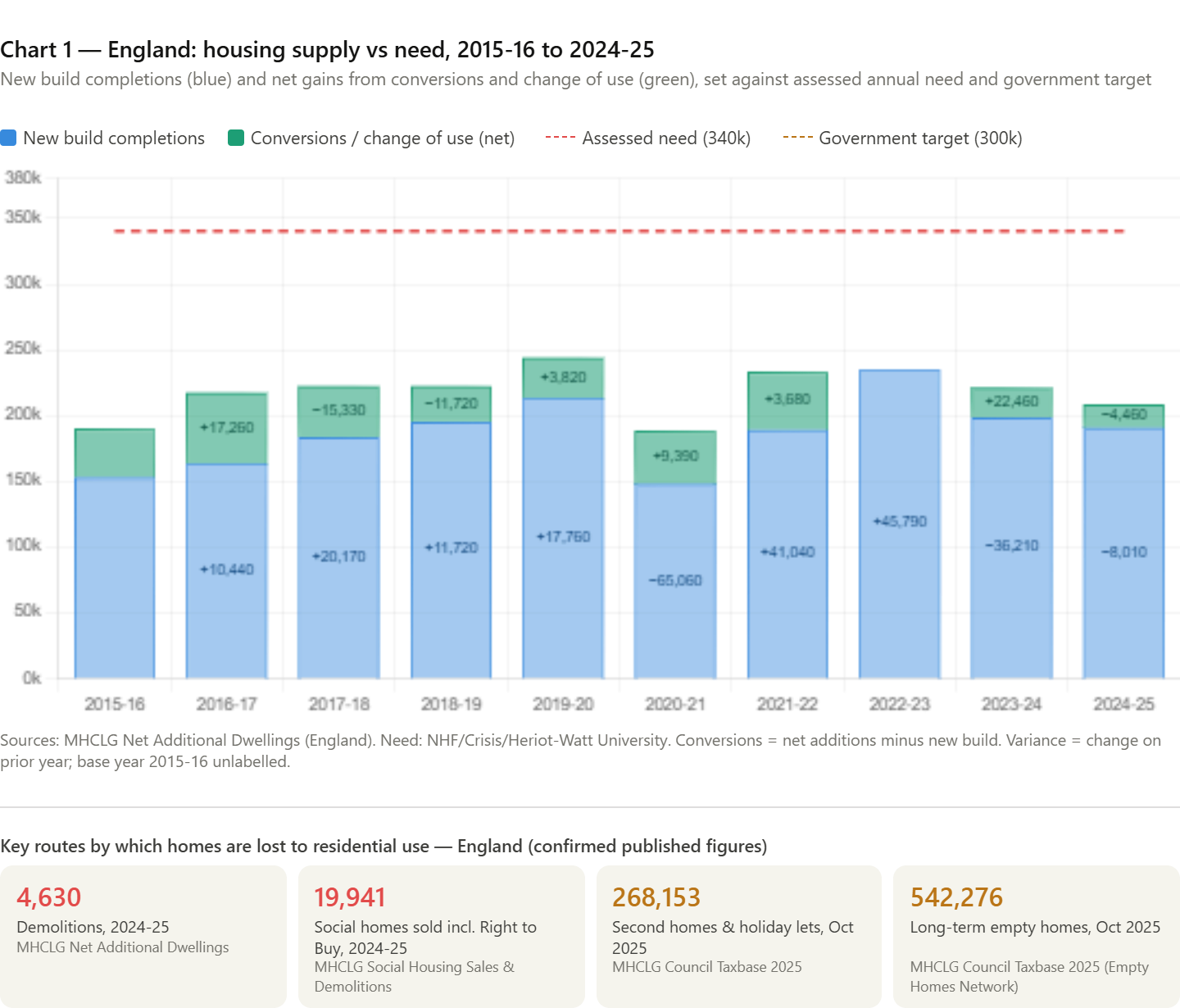
England’s primary measure of housing supply is net additional dwellings, published annually by the Ministry of Housing, Communities and Local Government. In 2024-25 it recorded 208,600 net additional homes. That figure sounds substantial until set against the independently assessed need of 340,000 homes per year, established by the National Housing Federation and Crisis in research by Heriot-Watt University. The gap has persisted throughout the decade shown. Even at the series peak of around 244,000 in 2019-20, England was still building barely 70% of what it needed.The supply shortfall is compounded by active losses. In 2024-25 alone, 4,630 homes were demolished, and 19,941 social homes were sold under Right to Buy and related schemes — removals from the social rented sector that are rarely matched by new social supply. The Council Taxbase 2025 data, published by MHCLG in November 2025, records 268,153 second homes and holiday lets across England, and 542,276 long-term empty homes — a combined figure of over 800,000 dwellings not serving as anyone’s primary residence.
Chart 2 — Northern Ireland
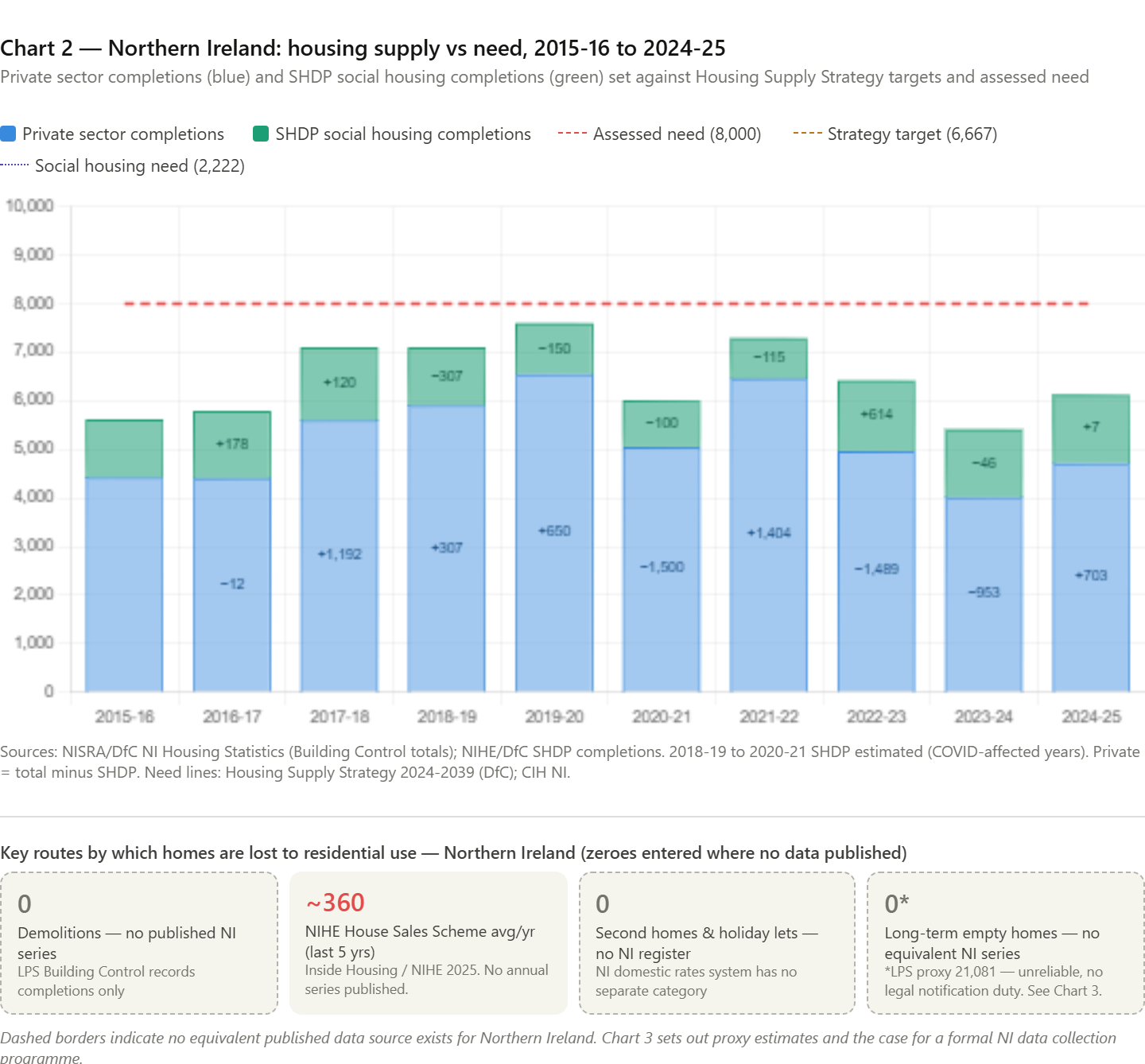
Northern Ireland’s Housing Supply Strategy 2024-2039, published by the Department for Communities, identifies a need for 8,000 new homes per year. The strategy’s own delivery target — 100,000 homes over 15 years — equates to just 6,667 per year. In 2024-25, Building Control recorded 6,125 new dwelling completions across all tenures, below even the strategy’s own modest target and less than 77% of assessed need.
Within that total, the Social Housing Development Programme delivered 1,410 new social homes against a strategy requirement of 2,222 per year — a delivery rate of 63%. The social housing waiting list stood at 50,381 households as at Q1 2026, the highest total since 2010, with 39,008 of those in housing stress. In 2024-25, 10,855 households were accepted as statutorily homeless.
Chart 3 — The data gap
Reference table — Chart 3 data
| Category | England | NI | NI status and source |
|---|---|---|---|
| Demolitions | 4,630 | — | No published series. LPS Building Control records completions only. Implied ~286 from stock arithmetic — unreliable as a standalone figure. Action: DfC/LPS to publish an annual demolitions return. |
| Social homes sold | 19,941 | ~360 | NIHE 5-year average (Inside Housing/NIHE, 2025). NIHE only — housing association right-to-buy closed August 2022 under the Housing (Amendment) Act (NI) 2020. No annual series published. Action: DfC to publish an annual social housing sales series. |
| Second homes & holiday lets | 268,153 | — | No register. NI domestic rates system has no second homes category. Action: cross-reference Tourism NI register with LPS Valuation List; introduce a separate second homes rates category. |
| Long-term empty homes | 542,276 | 21,081* | *LPS registered vacant April 2024 (DoF FOI DOF/2024-0465) — unreliable, no legal notification duty. England: MHCLG Council Taxbase 2025. Per capita rates broadly comparable (~21/1,000 England vs ~25/1,000 NI implied). Action: statutory vacant property register for NI with mandatory notification. |
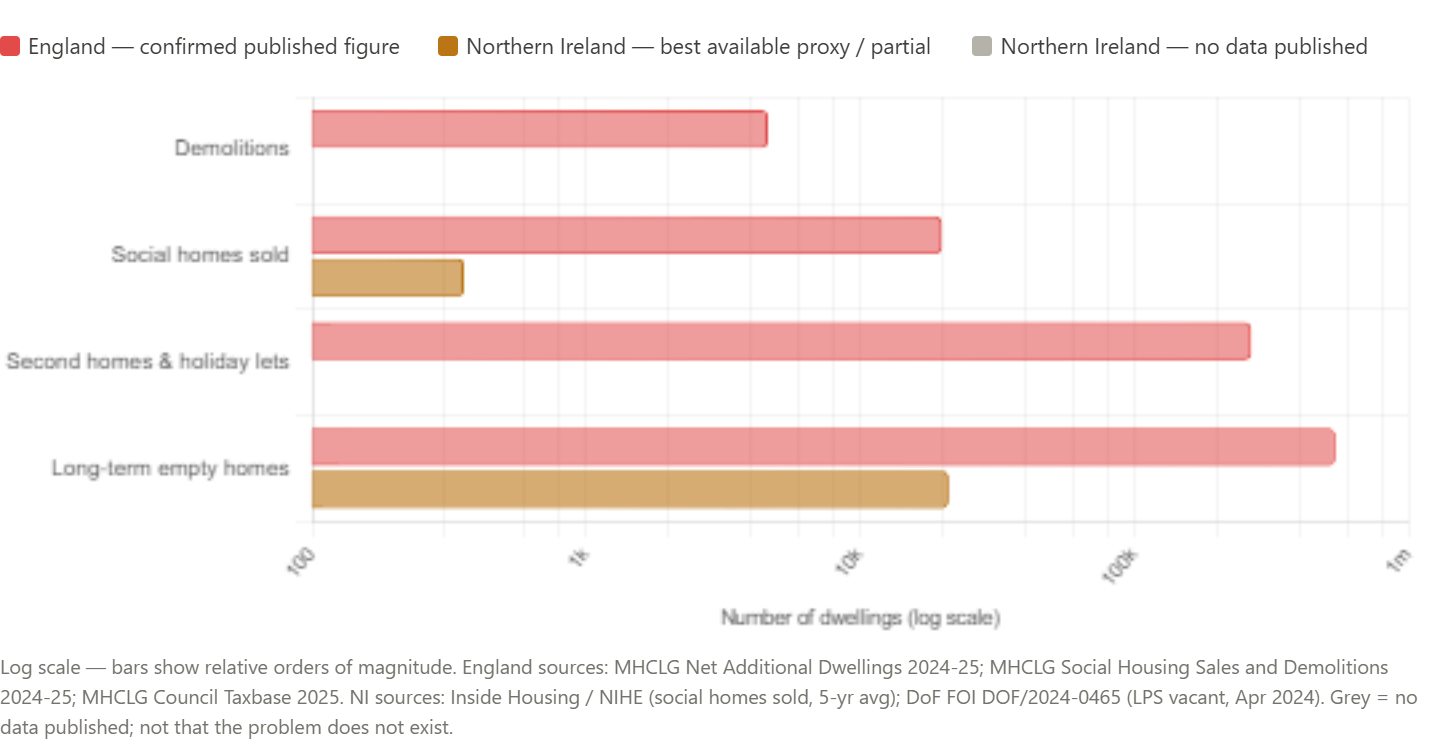
The data gap is itself the finding. England can quantify 4,630 demolitions, 19,941 social home sales, 268,153 second and holiday homes, and 542,276 long-term empty homes removed or withheld from residential use — because it collects the data.
Northern Ireland cannot make the equivalent calculation. Until DfC, LPS, and Tourism NI establish comparable annual series, the full scale of housing stock loss in Northern Ireland will remain invisible to policy, invisible to the Assembly, and invisible to the public.
England can quantify what it loses. Northern Ireland cannot. There is no published annual demolitions series for NI. There is no annual social housing sales series equivalent to the MHCLG release. There is no register of second homes or holiday lets — NI’s domestic rates system has no separate category for either. And there is no reliable count of long-term empty homes — the LPS registered vacant figure of 21,081 carries an explicit caveat from the Department of Finance that it is unreliable, because there is no legal obligation on ratepayers to notify LPS of vacancy.
Chart 3 sets the confirmed England figures alongside the best available NI proxies. The grey bars are not zeroes because nothing is happening. They are zeroes because no one is measuring it.
Four specific actions would close the gap: DfC and LPS to publish an annual demolitions return alongside Building Control completions; DfC to publish an annual social housing sales series covering both NIHE and housing association disposals; Tourism NI’s certification database to be cross-referenced annually with the LPS Valuation List; and the introduction of a statutory vacant property register in NI with a mandatory notification requirement on ratepayers.
The housing crisis in Northern Ireland is not simply a failure to build enough homes. It is also a failure to account for what is being lost. You cannot manage what you do not measure.