- BY Kevin Barry BSc(Hons) MRICS
- POSTED IN Latest News
- WITH 0 COMMENTS
- PERMALINK
- STANDARD POST TYPE
Eight Months to Polling Day: Will the Money Get Tested, or Just the Photo Opportunities?
A blog post for the Strangford Lough Crossing campaign
Northern Ireland’s voters go to the polls twice on the same day next year: council elections and Assembly elections, together, on 6 May 2027. Every capital project, every subsidy line and every “under review” answer between now and then will be weighed by the people making the decisions against a question that has nothing to do with sound public finance: how will this look on the doorstep in April?
That is the context worth holding in mind while reading two very different pieces of news from this side of Strangford Lough this month.
The number that just got tested
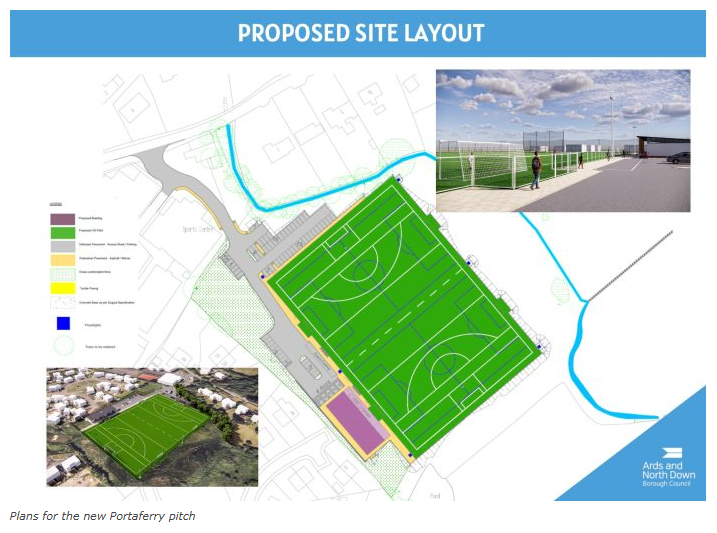
The Newtownards Chronicle reported (“Portaferry GAA pitch project faces funding shortfall as costs soar”, Joe McCann, 17 September 2026) that the Outline Business Case for the Portaferry GAA and multi-sports pitch, prepared in 2017, costed the project at £2.2 million. That figure went un-revisited for years while the project moved through committee, community expectation and delay. When it was finally tested this year, the true cost came back at more than £6.5 million, an increase of over £4 million.
Some of that gap is straightforward inflation, unavoidable across nine years. But not all of it, and arguably not most of it. The council’s own account of the shortfall lists earthworks, fencing, drainage and a larger car park among the items missing from the original 2017 figure, as though these were things nobody could have anticipated. They were not. A full-size 3G pitch cannot be built without site enabling works, boundary fencing or a drainage system beneath the synthetic surface; these are not later additions to the design, they are the design. An Outline Business Case that priced the pitch without them was not overtaken by events. It was under-scoped at the point it was written.
That matters for the wider argument, not less than the headline figure does. It means the £4 million-plus gap is not primarily a story about the passage of time. It is a story about what happens when a number is allowed to stand for nine years without anyone being required to check whether it ever covered the actual job.
Permission before price
There is a sequencing problem in how the pitch has been run, and it is worth naming clearly, because it is the same problem the campaign is trying to prevent from happening to the crossing question.
The Chronicle’s report sets out the order of events: a 2017 costing that turned out to exclude basic site enabling works, a planning permission application submitted in March 2026, and only after that, an updated business case and a decision to invest still to be brought to committee. Permission is being sought on the strength of a figure the council’s own report has already shown to be unreliable, with the true cost to be established afterwards.
This is not an accusation that anyone intended that outcome, but the mechanics are worth being honest about. Once planning permission is granted, a project stops being a proposal and starts being an asset with consent attached. Nine years of community expectation, a circulated artist’s impression, and a live planning approval all create pressure to find the money regardless of what the updated business case says, because the alternative is explaining to a Peninsula community why a permitted, long-promised facility was allowed to lapse. That pressure has nothing to do with whether £6.5 million represents good value. It exists regardless of the number.
Appraisal is supposed to come before commitment, not be backfilled once the political and practical momentum to proceed already exists. A business case that arrives after planning permission is not testing whether the project should happen. It is testing how the shortfall will be found.
To the council’s credit, the correction is at least happening in the open: a fresh estimate, a stated shortfall, a further report required before a further penny is committed. Badly scoped in 2017, but properly tested and disclosed in 2026.
The numbers that haven’t been tested at all
Compare that, imperfect as it is, to the two figures sitting behind the Strangford Lough crossing question, neither of which has ever been through an equivalent test, open or otherwise.
The ferry’s net annual subsidy is confirmed at £2.09 million (FOI DFI-2024-0366, 2023/24 operating costs £3.52 million against income of £1.434 million). It has been paid, unappraised, every year since the service was transferred internally in April 2023 with no business case, no Ministerial approval and no appraisal framework, TAG, NIGEAE, Five Case Model or PSA/Translink, ever applied to it (FOI DFI/2026-0357, 6 July 2026).
The alternative to that subsidy has been priced, in an Assembly answer (AQO 3527/22-27, 11 May 2026), at “in excess of £500 million.” No published derivation for that figure has ever been supplied. An internal departmental memorandum from 2024 (DFI-2024-0412, 22 August 2024) is candid enough to call the department’s own cost assumptions a “guesstimate,” and recommends against commissioning the study that might have tested it, on the grounds that doing so would give “false hope to elected representatives.”
Read that phrase again. The stated reason for not testing the number is the fear that testing it might raise expectations. That is not a financial judgement. It is a political one, made to manage how a decision will be received, not to establish what it will cost.
What eight months of “review” usually produces
Between now and 6 May 2027, the easiest path for anyone holding either budget line is to do nothing that can be turned into a difficult headline before polling day. Commissioning an independent feasibility study creates a paper trail and a number that can be quoted back at whoever approved it. Leaving an unevidenced subsidy running, and an unevidenced £500 million figure unchallenged, creates neither. One of those paths is accountable. The other is simply quiet.
That is the pattern worth naming, without needing to name any individual to make the point: capital decisions that are visible, popular and photographable tend to get made and defended, even when the underlying figures turn out to be wrong by a factor of three, as Portaferry has just shown. Decisions that would put a genuinely unresolved number to the test tend to get deferred, indefinitely, because nobody wants to own the answer in an election year, and because planning consent and public expectation can be used to force a budget allocation ahead of, rather than after, a properly tested business case.
The actual choice on the table
An independent, TAG-compliant feasibility study costs £250,000 to £500,000, per specialist industry advice already lodged in the public record. That is six weeks to two and a half months of the ferry’s current annual subsidy. It commits nobody to building anything. It does exactly what has just happened, unavoidably and imperfectly, at Portaferry: it forces a real number to replace an old one, in public, before nine more years pass and the gap gets bigger, and before consent or expectation is allowed to do the deciding that a proper appraisal should have done first.
The choice between now and May is not bridge versus ferry. It is tested numbers versus untested ones, and whether the public bodies spending this money are willing to find out what they are actually spending it on before they next ask for anyone’s vote.