
- BY Kevin Barry BSc(Hons) MRICS
- POSTED IN Latest News
- WITH 0 COMMENTS
- PERMALINK
- STANDARD POST TYPE
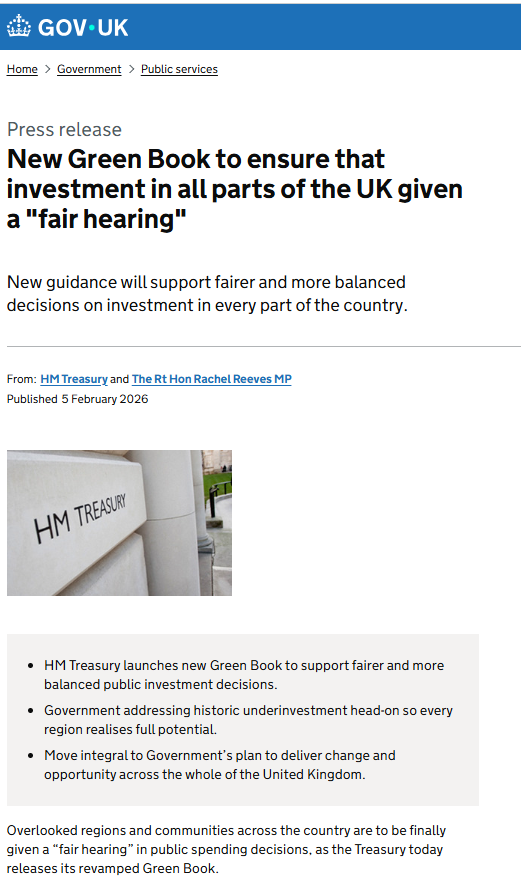
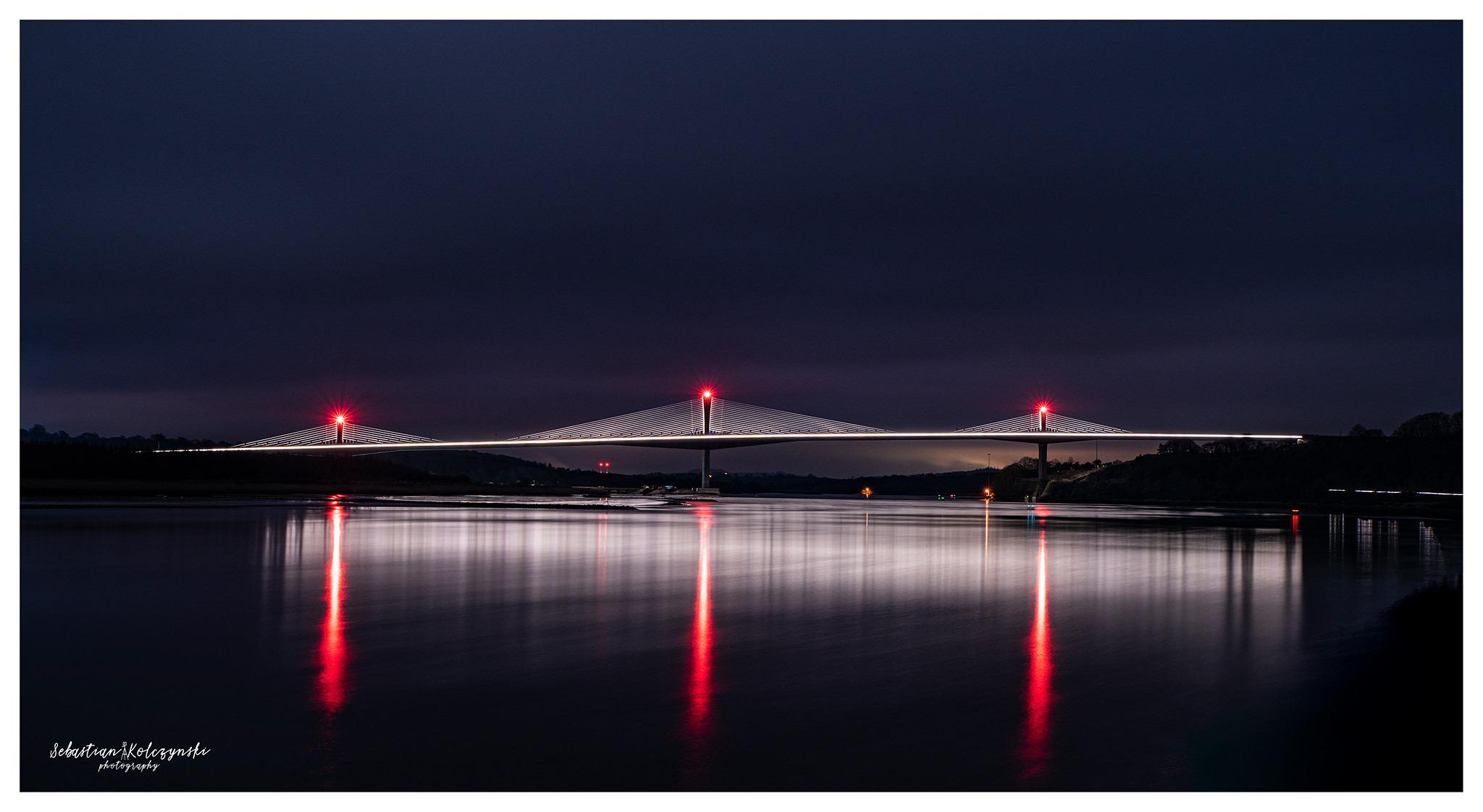
The New Green Book: Does the Strangford Lough Crossing Actually Stack Up?
Yes — the updated Green Book under Rachel Reeves reflects material changes in Treasury appraisal practice, especially around:
- the metrics and methodologies used to judge investment cases,
- the weight given to regional and transformational impacts, and
- the structure and usability of the guidance itself.
However, it’s a reform of guidance and framework rather than a change in statute. The core institutional role of the Green Book — to guide public investment appraisal — remains, but its application and emphasis are shifting.
People are rightly sceptical of big infrastructure promises.
So let’s strip this back and answer one simple question:
With the new Treasury rules, published today, 5th February 2026, does the Strangford Lough Crossing pass the test — or not?
What is the “new Green Book”?
The Green Book is the rulebook used by HM Treasury to decide whether public projects are worth funding.
For decades, it worked against places like ours.
Why?
Because projects were judged mainly on raw economic numbers:
- higher wages = higher “benefits”
- bigger cities = better scores
- rural areas = pushed to the back of the queue
That has now changed.
The new Green Book, launched by the Chancellor, explicitly says:
- projects must not be decided by a single BCR number
- rural, coastal and peripheral areas must get a fair hearing
- reliability, resilience and access matter — not just average journey times
That is a big shift. And with the GAA report published last week, demographics are going to have a serious impact on schools / businesses etc in the years ahead if the Ards Peninsula is left behind ! Everyone should voice their opinions and concerns and support a proper assessment of a permanent crossing of Strangford Lough. Any permanent crossing is the enabling works to the economic rebalancing and regeneration of the Ards Peninsula and the hinderlands surrounding the Lough.
What hurdles does the Green Book still require?
Let’s be clear: this is not a free pass.
Any serious project still has to show:
- A real problem
- A fair comparison of options
- Value for money (overall, not just on paper)
- Environmental constraints understood
- Costs and risks honestly stated
So — does the Strangford Lough Crossing (SLC) clear those hurdles?
1️⃣ Is there a real problem?
Yes. And it’s obvious to locals.
- The Ards Peninsula has one crossing
- If the ferry is disrupted, the alternative is a long road detour
- That affects:
- hospital access
- work and education
- trades, deliveries, tourism
- emergency response reliability
This isn’t about shaving two minutes off a commute.
It’s about single-route dependency, which only operates at 34%
The new Green Book explicitly recognises this type of problem.
2️⃣ Are alternatives properly tested?
They have to be — and that helps SLC, not hurts it.
Under the new rules:
- the ferry must be tested as a “do-minimum”
- upgrades, new vessels, and subsidies must be costed honestly
- long-term reliability limits must be acknowledged
If a cheaper ferry-based solution genuinely solves the problem — it wins.
If it doesn’t — the bridge option is justified.
That’s fair.
3️⃣ Does SLC rely on dodgy economics?
No — and this is crucial.
Old system:
“NI wages are lower, so time savings are worth less — project fails.”
New system:
“Show the full picture: access, resilience, reliability, fairness.”
The Green Book now says:
- BCR is not a pass/fail test
- projects with strong non-cash benefits can still be good value
For SLC, the strongest benefits are:
- guaranteed access
- reduced isolation
- reliability instead of uncertainty
Those now count properly.
4️⃣ What about the environment?
This is often used as a blocker — sometimes genuinely, sometimes lazily.
The new Green Book does not say:
“Ignore the environment.”
It says:
“Understand the constraints, cost the risks, design around them.”
For SLC that means:
- clear mapping of protections in Strangford Lough
- avoiding in-water impacts where possible
- being honest about cost and mitigation
Environmental issues are a design challenge, not an automatic veto.
5️⃣ Is this just political spin?
No — and this is important.
The Green Book is written by HM Treasury, not campaigners.
It applies to Northern Ireland Executive spending decisions whether people like it or not.
Officials are now required to look beyond headline numbers.
That is exactly what communities like ours have been asking for.
So what’s the honest verdict?
The new Green Book helps the Strangford Lough Crossing. Clearly.
Not because it guarantees a bridge —
but because it finally allows the right questions to be asked.
If SLC:
- solves a real access problem
- beats ferry upgrades on reliability
- can be delivered responsibly
- and is affordable over the long term
then under the new rules, it deserves to progress.
No smoke. No mirrors. No London-centric maths.
What happens next?
The right next step is not approval.
It is:
- a proper feasibility study
- an open comparison of options
- published evidence
- and a clear decision, one way or the other
That is how trust is rebuilt.
Bottom line:
The rules have changed.
For the first time in a long time, rural Northern Ireland is no longer structurally disadvantaged.
Now the Strangford Lough Crossing should be tested — properly, fairly, and in the open.
That’s not bull****. That’s progress.