
- BY Kevin Barry BSc(Hons) MRICS
- POSTED IN Latest News
- WITH 0 COMMENTS
- PERMALINK
- STANDARD POST TYPE
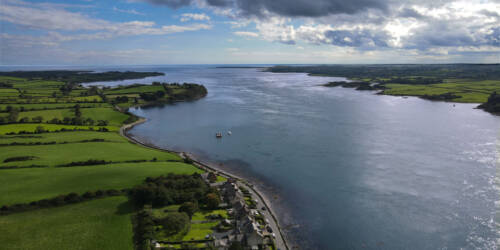
Kellie, thank you for engaging with the Strangford Lough Crossing proposal following the Chronicle coverage, which actually never mentioned SLC. MLA is simply requesting a feasibility study as part of a ‘focused, coherent plan’.
I appreciate you sharing your concerns via Facebook response to the article, and I’d like to address each point with the evidence that has informed this campaign.
LOCATION AND TOURISM IMPACT
You’re correct that a crossing would likely be at the Narrows – this has been the consistent location in all historical proposals dating back to 1840 (PRONI records). However, your concern about bypassing villages contradicts the empirical evidence from comparable infrastructure.
The Cleddau Bridge in Wales provides direct precedent. When Wales built their bridge in 1975 to replace the ferry (using the exact vessel that became our MV Portaferry), baseline average ferry traffic 237,400 crossings, bridge crossings grew from 885,900 to 4,745,000 annual crossings over 49 years – a 20-fold increase. This demonstrates that permanent infrastructure generates tourism growth rather than killing it off. Ask any local businesses if 3x traffic in the area would be welcomed over the first few years ? How growth develops, depends on economic policies implemented by NI Executive and Councils.
Community survey respondents specifically noted tourism benefits:
– “Better/alternative access would lead to…increased access to restaurants/shopping/entertainment opportunities”
– “Toll bridge would allow 24-hour access…meaning more flow of people through both Portaferry and Strangford to benefit local businesses”
– “Fife peninsula supports three bridges…without impact on nature and serves small communities well”
The HITRANS Corran Fixed Link Study (Scotland) found that similar concerns about village bypass were unfounded – connectivity increases passing trade and enables village growth rather than decline.
COST ASSUMPTIONS
You cite costs as “unaffordable” and mention very tall or opening bridge requirements. However, these assumptions don’t align with professional engineering analysis.
As a Chartered Quantity Surveyor, I’ve undertaken detailed cost analysis based on recent comparable projects:
Rose Fitzgerald Kennedy Bridge, Ireland (2020):
– 887m span (similar to Strangford 600m requirement)
– €230m construction cost
– Cable-stayed design (no opening mechanism required)
– 36m clearance height (adequate for marine traffic)
The Department’s £650m estimate (Ref: DFI 2024-0412) is explicitly described by the Divisional Roads Manager as a “guesstimate” – not professional engineering analysis. My professional QS analysis suggests £280-350m range, which while substantial, is lower than departmental assumptions.
Modern cable-stayed bridges do not require opening mechanisms – adequate air draft can be achieved through design, as demonstrated by the RFK Bridge and numerous other projects.
TOLL COSTS
Your concern about tolls being “far more expensive than current ferry tickets” fundamentally misunderstands the economic model.
Current ferry costs (2024): £7.70 single car fare
Annual ferry subsidy: £2.3 million taxpayer funding (for 34% capacity utilization)
Total ferry costs: £3.52 million annually (2023/24 DfI figures)
A bridge toll structure could match or undercut ferry fares while eliminating:
– 16-hour daily non-operation (ferry operates 7:30am-10:45pm only)
– Weather cancellations
– Mechanical breakdown disruption
– Capacity constraints (current 28-car limit)
The Cleddau Bridge operated toll-free initially and even with subsequent tolling generated massive traffic growth. The economic value comes from 24/7 reliability, not toll pricing.
ELECTRIFIED FERRY ALTERNATIVE
Your suggestion of an electrified ferry powered by tidal energy is technically interesting but doesn’t address the fundamental capacity and reliability constraints.
The current ferry operates at only 34% of its theoretical maximum capacity – yet still requires £2.3m annual subsidy. An electric ferry would:
– Still operate limited hours (current 7:30am-10:45pm schedule)
– Still face weather cancellations (fog, high winds, tidal conditions)
– Still require 75km detour when out of service
– Still impose 28-car capacity limit, and possibly lower (seen figures of 16-car limit or 2nr HGV)
– Still require crew staffing costs (£440k annually in 2013 figures)
– Still need backup vessel and dry-dock maintenance periods
Regarding tidal energy feasibility: The Narrows has extreme tidal currents (referenced in all historical bridge proposals since 1840 as “impracticable currents”). These same currents that challenge bridge engineering also make tidal energy extraction complex and potentially conflict with ferry operations.
The QUB trials and Bangor-Belfast passenger ferry are different scales entirely – the Bangor service is 12 nautical miles in sheltered waters, not a high-current narrows crossing with vehicle capacity requirements.
FOG LEGISLATION
You suggest legislation to keep the ferry route clear would reduce fog cancellations. However, fog cancellations are driven by Maritime and Coastguard Agency (MCA) safety requirements, not route obstruction. Visibility-based operational limits cannot be legislated away – they’re fundamental maritime safety requirements.
Legislators cannot foresee every operational scenario. Even if company policy suggests operations may continue in fog, the master retains the right— and duty — to refuse if they believe it is unsafe (Source: HMCG)
A bridge operates in all weather conditions that allow road travel, eliminating weather-dependent service disruption entirely, with the exception of high sided vehicles in high wind/storm conditions.
MAJORITY TRAVEL VIA A20
You correctly note that the majority of Peninsula travellers uses the A20 northward rather than the ferry. However, this demonstrates suppressed demand rather than lack of need for the crossing.
The ferry operates at 34% capacity utilization despite this being the shortest route – people avoid it due to:
– Limited operating hours (From Portaferry, first boat is 7.45am, with queuing before 7am to try and guarantee space on boat)
– Unreliability (weather, mechanical issues)
– Capacity constraints (queuing uncertainty)
– Cost for frequent users
Cleddau Bridge evidence shows that when a reliable permanent crossing is provided, traffic grows exponentially because suppressed demand is released. Year 1 crossings were 3.73 times the ferry baseline – people who previously avoided the crossing due to constraints suddenly used it when reliability improved.
BETTER ROAD SYSTEM UP PENINSULA
I completely agree that Peninsula road infrastructure requires improvement – this is not an either/or proposition. The Sub-Regional Economic Plan (October 2024) and Eastern Transport Plan 2035 should address both.
However, a proposed new white elephant “safer central route” still leaves Peninsula residents facing:
– 75km detour vs 8-minute crossing
– No 24/7 emergency healthcare access to Downpatrick Hospital
– Geographic isolation constraining employment opportunities
– Wage depression (Ards & North Down ranks 11th of 11 NI councils for median wages)
COMMUNITY CONSULTATION AND BUSINESS CASE
You state “such changes needs to have community consultation, environmental impact assessments and a clear business case.” I agree entirely – this is precisely what the campaign requests.
The Department has refused to commission a feasibility study, meaning:
– No community consultation has occurred
– No Environmental Impact Assessment undertaken
– No business case developed using proper WebTAG transport appraisal methodology
Refusing to conduct feasibility assessment prevents the very consultation and evidence gathering you correctly identify as necessary.
Community support is already evident: 94% of survey respondents (458 responses, November 2024) believe the ferry is “not fit for purpose.”
REGARDING “PARTICULAR COMPANIES/INDIVIDUALS PUSHING”
This characterization concerns me. The Chronicle article never mentioned SLC www.strangfordloughcrossing.org
The campaign has:
– Cross-party political support (DUP, Sinn Féin, SDLP MLAs)
– 94% community backing from extensive public survey
– Recognition in Assembly debates (Hansard, 25 November 2025)
– No commercial drivers – I receive no compensation for this advocacy
Dismissing evidence-based infrastructure analysis as corporate lobbying undermines substantive policy discussion. The £3-4 billion economic value over 30 years and 7,500-18,000 job creation potential represent transformational regional development, not special interest lobbying. Otherwise known as helping local people.
CONCLUSION
I respect that you have different views, but I’d encourage reconsideration based on:
1. Cleddau Bridge empirical evidence (20-fold traffic growth over 49 years)
2. Professional QS cost analysis (£280-350m vs departmental “guesstimate” of £650m)
3. Community survey evidence (94% support)
4. Cross-party political consensus
5. Healthcare access transformation (24/7 emergency services)
6. Economic impact modeling (£3-4bn over 30 years)
An electrified ferry addresses emissions but not capacity, reliability, operating hours, or geographic isolation. Peninsula road improvements are necessary but don’t address the fundamental connectivity constraint.
The evidence base supports what Michelle McIlveen MLA and cross-party colleagues recognize: strategic infrastructure enables regional transformation rather than waiting for growth to justify investment, growth which shall never materialize without radical measures, with current policies only leading to growing congestion as evident in Newtownards.
I remain happy to discuss the evidence base further and would welcome Alliance Party engagement with the comprehensive analysis available at www.strangfordloughcrossing.org
Yours sincerely,
Kevin Barry BSc(Hons) MRICS
Chartered Quantity Surveyor