- BY Kevin Barry BSc(Hons) MRICS
- POSTED IN Latest News
- WITH 0 COMMENTS
- PERMALINK
- STANDARD POST TYPE
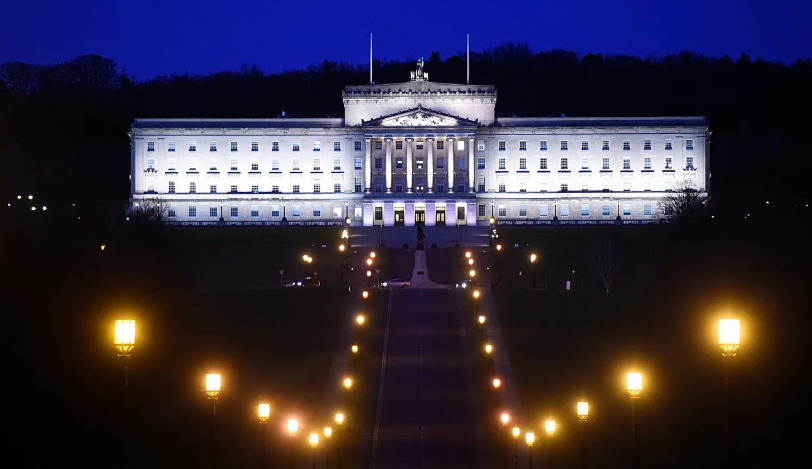
The Case for Resilience: Why the Ards Peninsula Cannot Afford to Rely on One Crossing
Strangford Lough Crossing (SLC) Campaign — for the latest evidence and updates, visit www.strangfordloughcrossing.org
Michael O’Leary built Ryanair on one uncomfortable question: what happens when your only aircraft is grounded? You do not run an airline, or a country, on the assumption that nothing will ever go wrong. You build redundancy in, price it properly, and let the numbers do the arguing. It is worth asking Stormont the same question about the Ards Peninsula’s only fixed link to the rest of Northern Ireland: what happens when the A20 Portaferry Road and the Strangford Ferry fail on the same night?
We now have the Assembly’s own record of the answer.
What Hansard actually says
In the Adjournment debate on the impact of storms on the A20 Portaferry Road, held in the Assembly on Tuesday 3 February 2026 (Official Report, Plenary, 3 February 2026), Kellie Armstrong MLA told the House that during Storm Bram in December, a school bus travelling the A20 was struck by waves, and that children were left stranded by coastal flooding. She described this as avoidable and said it exposed “a failure in coordination between DFI Roads, the PSNI, local schools and the media.”
Harry Harvey MLA gave further detail in the same debate: during Storm Bram, dozens of cars were abandoned in floodwater 2 to 3 feet deep near the sailing club, and a bus full of schoolchildren was left stranded, with the coastguard called to the scene. He noted the road had also been closed more recently by Storm Chandra, which Michelle McIlveen MLA placed as having struck “last week” relative to the debate itself, some weeks after Bram.
Matthew O’Toole MLA made the connective point directly to the Minister: storm disruption that closes the A20 “might often disrupt the ferry crossing from Portaferry to Strangford,” which he said put “even more emphasis on planning, preparing and building in resilience” for peninsula residents.
None of this is campaign conjecture. It is what elected representatives said, on the record, to the Minister, in February 2026. What it establishes is simple and uncomfortable: the road and the ferry are not two independent routes. They are two expressions of the same single point of failure, and when the weather turns, both can go down together.
The O’Leary test: where is the contingency plan?
An airline that had no diversion plan for its single hub airport would not survive a regulator’s audit, let alone a storm season. Yet FOI DFI/2026-0415 (Department for Infrastructure, response dated 5 August 2026) confirms that DfI holds no recorded fleet condition analysis, no vessel replacement business case, and no record that a fixed crossing was ever considered as an alternative to the ferry. FOI DFI/2026-0357 (6 July 2026) confirms the ferry was transferred internally within DfI in April 2023 with no business case, no Ministerial approval, and no appraisal framework applied.
Put plainly: the sole crossing serving the Ards Peninsula’s southern tip has never been subjected to the kind of resilience planning that any commercial operator would insist on before putting it into service. Mike Nesbitt MLA made a version of this point himself in the same debate, noting that “DFI Roads has no five-year plan” for the A20 — a point Mr Mathison directly corroborated moments later, telling the House “Mike Nesbitt talked about a five-year plan.” The campaign’s consistent argument is that this gap in planning, not any single storm, is the real story.
Why redundancy matters beyond the weather
Storms are the clearest illustration, but they are not the only reason serious infrastructure planning builds in more than one route. Elsewhere in the Assembly this year, Members have discussed a markedly less benign backdrop: increased defence spending, instability on Europe’s eastern front, and, as Deputy First Minister Emma Little-Pengelly put it to the Assembly on 11 May 2026, disruption around undersea cables as part of the wider pattern of hostile activity affecting these islands. That is a debate about the aerospace, defence and security sector rather than about Strangford Lough directly, and the campaign is careful not to overstate the link. But the underlying planning principle is one any Minister would recognise: a region with only one road out and one small vessel serving it has no redundancy to fall back on, whether the disruption is a storm surge, a mechanical failure, or something with a harder edge. A fixed crossing does not solve every contingency. It does close the single biggest gap: a route that functions in the great majority of weather conditions a ferry cannot sail in, and that cannot be cancelled for a mechanical fault the way DfI’s own reporting to Newry, Mourne and Down District Council and to Ards and North Down Borough Council (both Annual Reports 2024/25, Section 5) confirms happened 550 times in 2023/24 through industrial action alone, and a further 158 times for mechanical and technical issues.
A hand up, not a handout
This week, Stormont ministers wrote collectively to the new Prime Minister, Andy Burnham, asking for what they termed a “fair funding envelope,” pointing out that funding parity with Wales would be worth an additional £1 billion a year to the block grant, and parity with Scotland around £3 billion. That is a legitimate ask, and it is the Executive’s ask, not the campaign’s.
The Strangford Lough Crossing campaign is deliberately not making that ask. Where the Executive’s letter to Downing Street seeks recurring funding to sustain public services, the campaign’s ask is a one-off feasibility study, costed at £250,000 to £500,000 on specialist industry advice, to test whether a crossing can be delivered as an investment that pays its own way through tolling, not a subsidy that recurs every year. The ferry’s own FOI-disclosed figures (FOI DFI-2024-0366, response dated 9 October 2024) show operating costs of £3.52 million against income of £1.43 million in 2023/24 alone, a net cost to the public purse of roughly £2.09 million that year, and every year, indefinitely. A bridge, once built, does not need re-funding every twelve months. That is the O’Leary discipline in a sentence: stop paying for the same underperforming asset year after year, and instead test, with proper commercial rigour, whether a one-off capital investment removes the recurring cost altogether.
This is the fishing rod, not the fish. It is a request for the tool to establish whether the region can build its own economic capacity, not a request for Westminster to keep feeding a subsidised ferry that cannot run in a storm, has no five-year resilience plan, and stops thousands of people, patients, schoolchildren and commuters alike, in their tracks whenever the wind gets up.
The ask
The Minister, Liz Kimmins MLA, told the Assembly on 3 February 2026 that she was “happy to keep that under review.” That review is overdue. Full sourcing, the interactive appraisal dashboard, and the traffic data behind these figures are all published at www.strangfordloughcrossing.org.