- BY Kevin Barry BSc(Hons) MRICS
- POSTED IN Latest News
- WITH 0 COMMENTS
- PERMALINK
- STANDARD POST TYPE
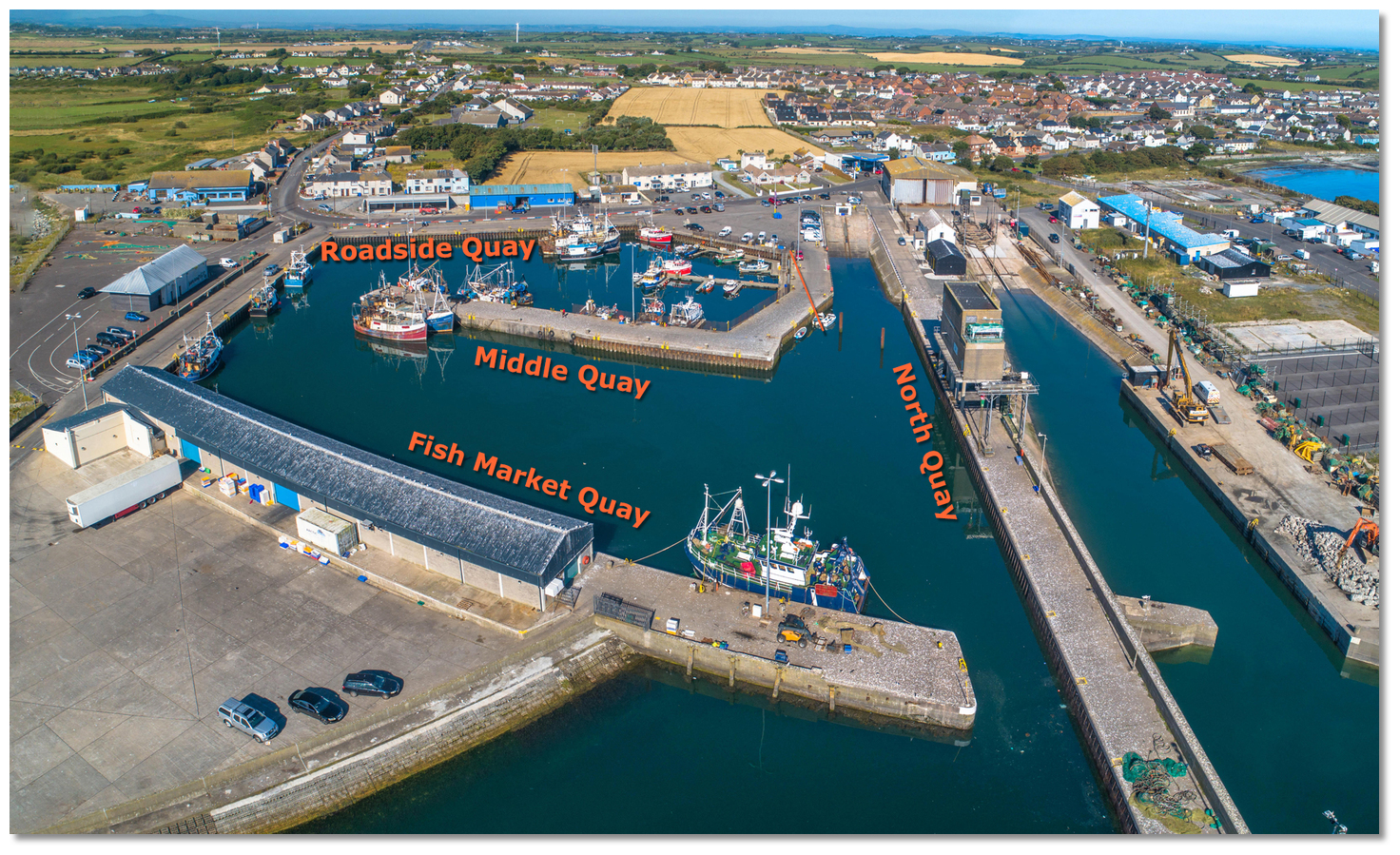
Portavogie Harbour
A Portavogie Parent’s Question: How Does Our Child Get a Good Education — and Come Home to Build Something?
Kevin Barry BSc(Hons) MRICS — strangfordloughcrossing.org
In an earlier piece this week I argued that the case for a Strangford Lough crossing is, at heart, a case about option value — the value of keeping doors open for our children and grandchildren, even for journeys we don’t yet know they’ll want to make. This post is the practical sequel. It takes that idea down to the kitchen table.
Sit at a kitchen table in Portavogie, Millisle or Donaghadee on a Sunday evening and the conversation that comes round, eventually, is the one about the children. Where will they go to college. Whether they’ll come back. Whether there’ll be anything to come back to.
It is a fair question, and it deserves a fair answer — rooted in what is actually happening on the ground, and free of the labels (“NEET”, “left behind”) that get attached to young people from coastal communities by people who have never lived in one. The honest answer in 2026 is that the Ards Peninsula has more genuine options than at any point in a generation. Ardglass and Portavogie remain two of the biggest fishing ports in the United Kingdom. Downpatrick and Newry have college campuses that quietly turn out engineers, joiners, care workers and IT specialists every year. And — the news that changes everything — from September 2026 a Queen’s University degree will be available six miles south of the border in Dundalk.
The piece of road that decides whether a Portavogie family can take advantage of all three is the half‑mile of water at the Strangford Narrows.
The industry our children would come home to
Start with what already exists, because the assumption that “there’s nothing here” is wrong.
Portavogie is a working commercial fishing port on the family’s doorstep — famous for its prawns and herring, with a large fleet of trawlers (NIFHA). Ardglass, twelve miles across the lough as the crow flies, is home port to over 30 vessels and the hub of Northern Ireland’s pelagic processing industry (NIFHA). Together with Kilkeel, these three County Down ports account for first‑hand landed value in excess of £30 million in recent years, support around 1,550 full‑time equivalent jobs in catching and processing, and generate an estimated £55.5 million in GVA across the wider seafood cluster every year (DAERA Fishing & Seafood Development Programme, 2021). All three sit in the UK top 20 for landings by value (UK in a Changing Europe).
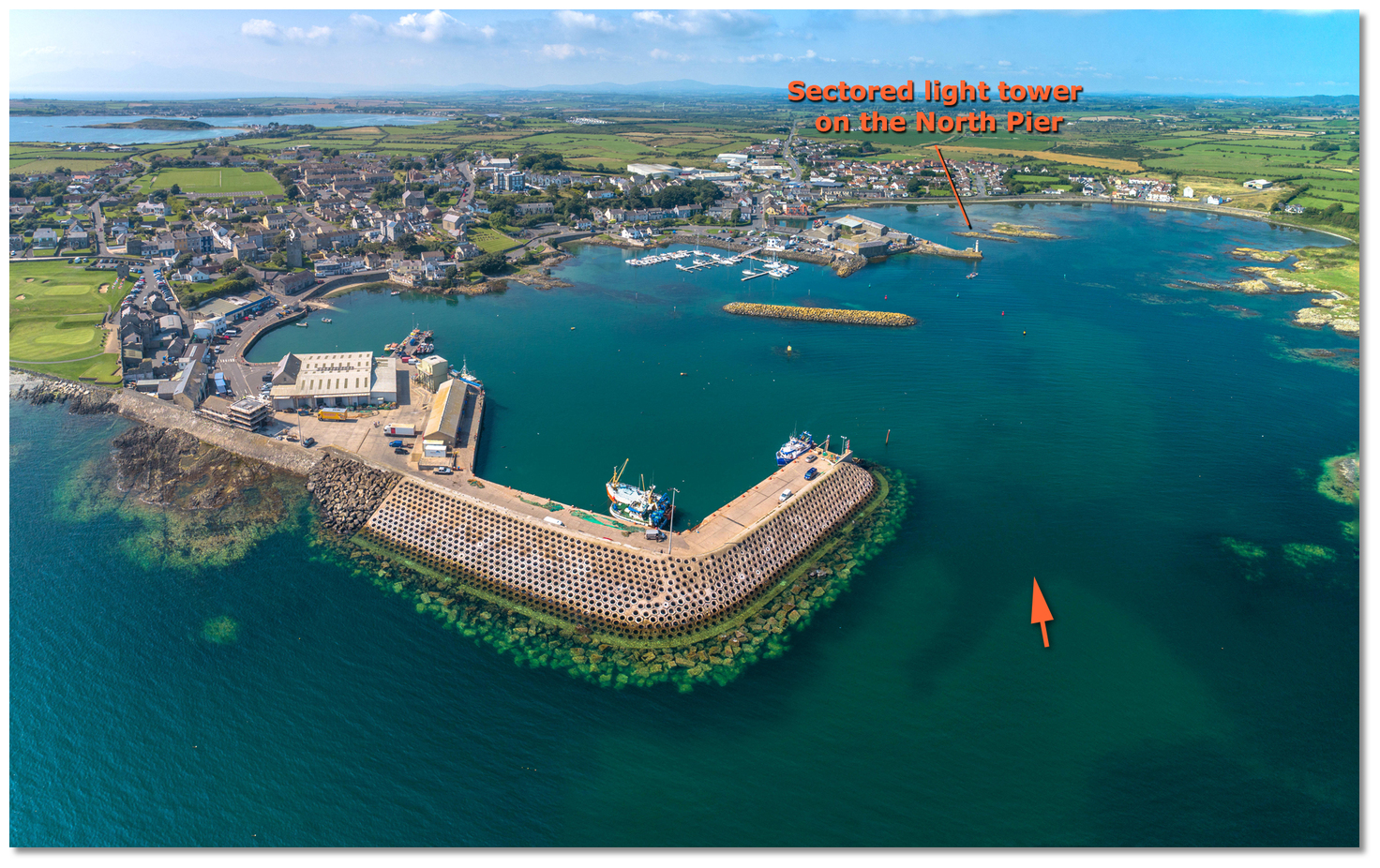
Ardglass harbour
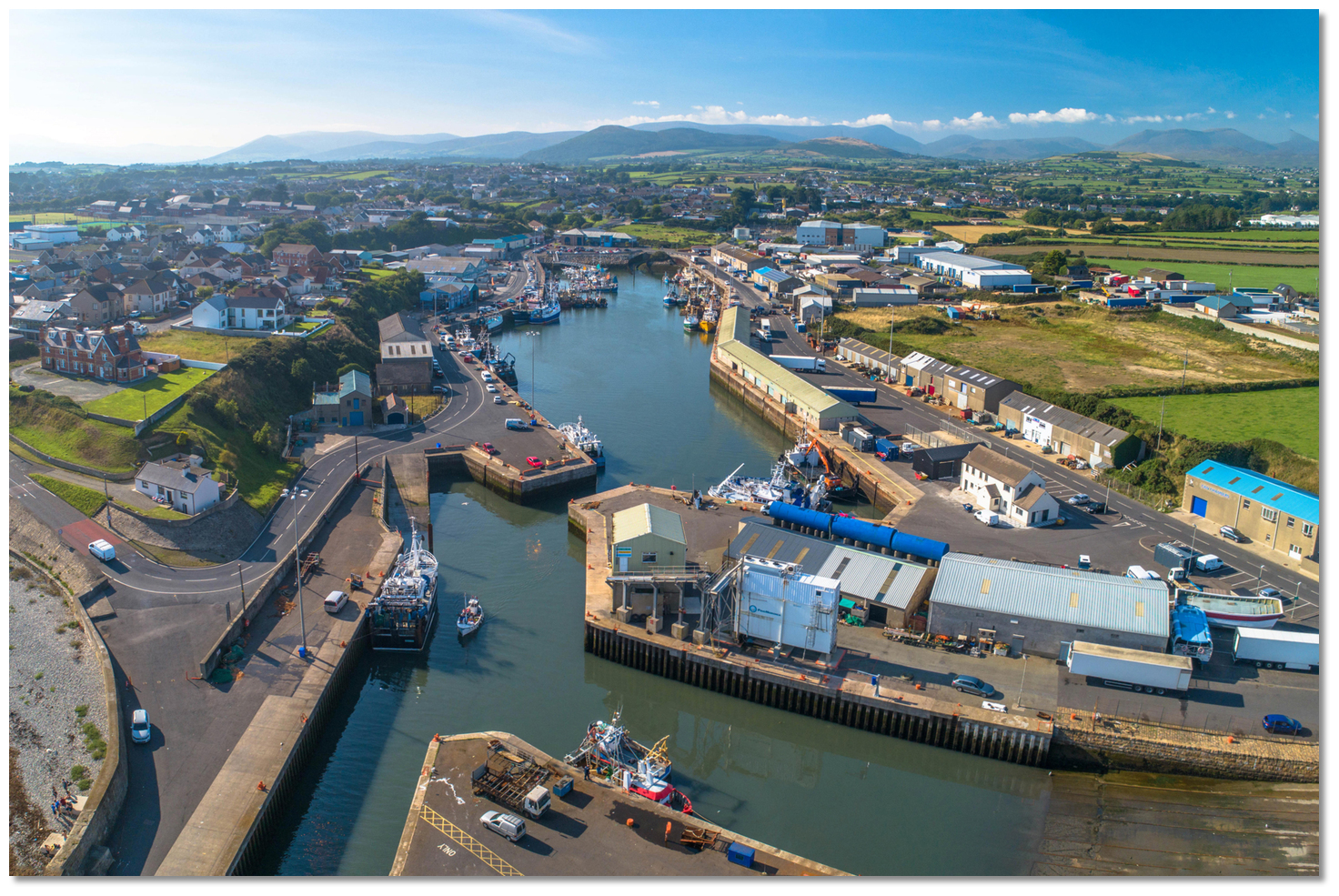
Kilkeel Harbour
Fishing alone will not absorb the next generation — the fleet is consolidating, and any honest conversation has to admit it. What matters is what surrounds the fleet. Invest NI has identified that Northern Ireland’s offshore vessel services sector — the engineers, electricians, welders, boat repairers and guard‑vessel operators who already supply the fleet — could double to more than £20 million per annum on the back of Irish Sea offshore renewables (DAERA FSDP, 2021). The Strangford and Lecale AONB review makes the same point from the other side: there are real opportunities to adapt traditional maritime skills and equipment for offshore renewables (Strangford and Lecale AONB).
This is the wealth your child could come home to build. It is not nostalgia. It is engineering, marine services, processing, logistics, aquaculture and R&D — clustered around three harbours that already exist and already work.
The qualifications they need — and where they’re taught
So what does a young person from Donaghadee or Portavogie need on paper to fill those jobs, or to start the business that employs other people in them?
Two colleges within reach do most of the heavy lifting:
- SERC Downpatrick specialises in engineering, motor vehicle, construction trades, computing, hospitality, health and care, early years and animal care, with higher‑education enrolment running across Bangor, Downpatrick, Lisburn and Newtownards (SERC Downpatrick Campus; SERC).
- Southern Regional College (SRC) Newry offers HNCs, HNDs, foundation degrees, full degrees and Higher Level Apprenticeships across faculties including Building Technology & Engineering and Health & Science (Southern Regional College; Wikipedia: SRC).
These are not consolation prizes. Higher Level Apprenticeships in particular let a young person earn a wage, gain hands‑on experience and finish with a qualification that maps directly onto the offshore services, marine engineering and construction sectors growing locally — without the student debt.
The catch, for a parent in Portavogie or Millisle, is the daily journey.
Downpatrick is, on the map, just across the lough. The car drive from the Ards side via Newtownards, Comber and Saintfield is the long way round. The Strangford ferry shortens it — but only when it is running, and only when there is space. SERC’s campus structure assumes a regional bus and car catchment that the ferry timetable simply does not deliver reliably for a 9 a.m. start. Newry is harder again: it requires a drive south through Newcastle or via Belfast, because the eastern crossing isn’t there.
For a Donaghadee family the practical question becomes “can our daughter do an Engineering HND at Newry as a daily commute, or does she have to move out?” Today the honest answer is usually “move out.” That is not a course problem. It is a road problem — exactly the kind of would‑be trip that never happens, which the earlier piece flagged as the real, invisible cost of leaving the lough as a hard line on the map.
The game‑changer: a Queen’s degree, 30 miles down the road
Now overlay what happened on 19 November 2025. Queen’s University Belfast and Dundalk Institute of Technology confirmed a strategic partnership under which DkIT becomes a university college of Queen’s, with students enrolling from September 2026 graduating with a Queen’s University Belfast degree (Times Higher Education; BBC News NI). The Irish government has since secured Cabinet approval to draft the enabling legislation (Department of Further and Higher Education, Ireland).
In plain English, for a family in Millisle:
- From September 2026, your son or daughter can sit a degree programme in Dundalk and graduate with a Queen’s University Belfast degree — the same Russell Group qualification awarded in Belfast.
- The Dundalk campus is being explicitly developed as a Joint Research and Innovation Hub, with lead projects expected in health and life sciences, and energy and sustainability — exactly the disciplines that feed back into the offshore renewables, marine engineering and processing economy on this coast.
- The whole arrangement is being built around the Dublin–Belfast corridor, with student mobility, shared learning and industry partnerships across the island (Fianna Fáil).
For the first time, a Donaghadee family has a credible second option to Belfast for a full degree. The student lives at home or in shared digs in Newry, travels to Dundalk, and graduates with a Queen’s qualification that opens the same doors as the Belfast version. The fees, the cross‑border living costs, and the proximity to Republic of Ireland employers along the M1 make this a genuinely different financial proposition to four years on University Road.
But that second option is only as real as the road network that gets you to it. And right now, that road network has a half‑mile gap in it.
The half‑mile that decides everything
From Portavogie to Strangford by car is a short, scenic run down the peninsula. From the Strangford slipway to Downpatrick is eight miles (Rome2Rio). Downpatrick to Newry is a manageable cross‑country drive, and Newry to Dundalk is fifteen minutes on the A1/N1.
The whole chain — Portavogie kitchen table to Queen’s degree at Dundalk — comes apart at one point: the Strangford Narrows. Without a fixed crossing, the family is dependent on the ferry timetable for every commute, every interview, every weekend home from digs, every emergency trip back when something goes wrong. With a fixed crossing, the chain is continuous: peninsula to Downpatrick to Newry to Dundalk, on a road that opens at midnight and at 6 a.m., that doesn’t cancel in a southerly, and doesn’t queue an hour deep on a bank holiday.
The European Commission’s 2025 review of rural transport inequality is blunt about what this kind of bottleneck does: it is now recognised as one of the strongest predictors of who progresses into higher education and who does not (European Commission, 2025). In our case the bottleneck is a 0.6‑mile gap of water that a modest, well‑designed structure can close.
This is exactly where the option‑value argument lives. As set out in the earlier piece, the international evidence on new bridges and rail links is consistent: when a journey becomes simpler, safer and more reliable, families and businesses quietly reorganise their daily routines around the easier option, and the gains accrue most to those previously most constrained — young people, older people, households without a second car. A fixed Strangford crossing would not force a single family to send a child to Dundalk, or Newry, or Downpatrick. It would simply make all three a live option, every day, for every household on the peninsula.
What a fixed crossing changes for your child
Put it together from the kitchen‑table point of view:
- At 16–18, your child has SERC Downpatrick as a realistic daily option for engineering, construction trades, computing or care courses — by direct bus, not a two‑ferry day.
- At 18–21, SRC Newry’s HNCs, HNDs and Higher Level Apprenticeships become a commute, not a relocation. They earn while they learn, on courses that map directly onto the offshore services and marine engineering economy at home.
- At 18–22, the Queen’s degree at Dundalk is on the table as an alternative to Belfast — same qualification, lower living costs, closer to home, and embedded in the cross‑border research hub that will be looking for placement students from the Irish Sea coast.
- At 22 onwards, they come back to a Portavogie, Ardglass or Donaghadee that is no longer at the end of a road. It is on the road — the same Dublin–Belfast corridor that Queen’s and the Irish government are now formally building their strategy around.
That is what “creating wealth at home” looks like in practice. Not a single big employer parachuted in, but a generation of qualified young people from the peninsula, able to access the best of north and south, then settling where their families are and putting their skills into the industrial base that already exists — fishing, processing, marine engineering, offshore services, construction, care, hospitality.
A hand up, not a hand out
This is the part of the argument that matters most, and it should be said plainly.
A fixed crossing does not write a cheque to a single household. It does not subsidise a business that wouldn’t otherwise stand on its own feet. It does not pay anyone to stay where they are. It simply removes a physical barrier so that a young person in Portavogie or Millisle who is already willing to put in the work — to sit the HND, to commute to Newry at 7 a.m., to do the apprenticeship, to graduate from Queen’s at Dundalk and come back with the qualification — can actually do those things from their own kitchen.
The effort still has to come from the family. The crossing just stops penalising them for living on the wrong side of the lough.
That is the definition of a hand up, not a hand out. And it is the kind of infrastructure decision that pays itself back over a generation, not a political cycle.
The decision in front of us
The Queen’s–Dundalk announcement is the biggest piece of education news on this island in a generation, and it has happened almost entirely below the radar in east Down. The DAERA report on fishing infrastructure has been costed and on the shelf since 2021. The colleges in Downpatrick and Newry already teach the right courses. The harbours already land the fish.
The question for a parent in Portavogie, Millisle or Donaghadee is not whether their child has options. The options exist. The question is whether the road network is going to let their child use them — or whether east Down will, once again, watch a generation of opportunity drive around it.
A fixed crossing at Strangford is the shortest, cheapest piece of infrastructure that turns three separate good‑news stories into one coherent local economy. It is, in the language of the earlier piece, the cleanest piece of option value on offer to this region — a modest structure that gives every household on both shores a new daily choice, and lets the next generation decide for themselves whether to take it.
The opportunities and rewards are significant. Prosperity can genuinely be shared on both sides of the lough. The feasibility study decision is where the community finds out whether actions speak louder than the encouraging words “why not?”
To compare the limited scale and complexity of SLC, refer to the following B1M video covering connectivity measures under the Faroe Islands.
Sources are linked inline. This post draws on the earlier Quintin QS blog on option value (June 2026), the DAERA Fishing & Seafood Development Programme (2021), NIFHA harbour profiles, the November 2025 Queen’s–DkIT partnership announcements, the Irish Government’s April 2026 legislative authorisation, SERC and SRC course information, the European Commission’s 2025 rural transport inequality review, and current travel data for the Ards Peninsula, Downpatrick, Strangford, Newry and Dundalk.