
- BY Kevin Barry BSc(Hons) MRICS
- POSTED IN Latest News
- WITH 0 COMMENTS
- PERMALINK
- STANDARD POST TYPE
STRANGFORD LOUGH CROSSING CAMPAIGN
From the Front Pages of Today to the Front Pages of 2032
The Ards Chronicle placed the campaign on its front page on 12 March 2026. Six years from now, three of Northern Ireland’s leading newspapers could carry a very different story — if the Department for Infrastructure acts now.
Kevin Barry BSc(Hons) MRICS | Strangford Lough Crossing Campaign | strangfordloughcrossing.org
What the Papers Are Saying Today
On Thursday 12 March 2026, the Ards Chronicle carried two stories occupying the better part of pages 6 and 7 of that edition. The first reported that a local survey published in November 2024 found that 90 per cent of respondents were in favour of an alternative crossing of Strangford Lough, with only 2.3 per cent preferring neither a bridge nor a tunnel. The second story reported that SDLP Councillor Joe Boyle had called for more Strangford ferry sailings, citing what he described as an unacceptable standard of service — a service which he argued was treating Ards Peninsula residents as second-class citizens.
Taken together, these two front-page stories set out the case with clarity. The community has spoken: demand for improved connectivity is real, documented, and cross-community. The ferry service, operating within fixed capacity constraints and subject to repeated disruption, is not an adequate long-term response to that demand.
The Ards Chronicle coverage also recorded a number of significant statements from elected representatives and community figures, all of which bear noting here.
Alderman Robert Adair, who has led the call for a Ministerial letter requesting a feasibility study, was quoted as saying that the Infrastructure Minister had agreed not to rule out carrying out a feasibility study if there was the political will and the economic case for it. Mr Adair urged the committee to send a united message to Stormont.
Independent Councillor Tom Brady was quoted as saying that a bridge was not already in place given the incredibly long drive faced by local residents when the ferry service was unavailable.
SDLP Councillor Nigel Edmund was quoted as saying he was carrying on the family tradition of campaigning for the bridge as he followed in the footsteps of his late uncle, Joe Hagan.
Councillor Craig Blaney said he was more than happy to support the council writing to the Infrastructure Minister to request the feasibility study, provided the department was paying for the study and not the council.
SDLP Councillor Joe Boyle, speaking on the ferry service, was quoted as saying he had fought for 30 years for a new vessel for the Strangford Ferry Service and had achieved an earlier morning crossing during the period of the MV Strangford. He further stated that during that time he had fought for and not achieved the 7am sailing from Portaferry. He described people on the Ards Peninsula as being deprived of lifestyle and employment opportunities, noting that for 30 years the area had been told it had to fight to achieve necessary and required travel arrangements.
These statements, from councillors representing Alliance, DUP, SDLP, and independent voices, represent an unusually broad consensus. The campaign has consistently noted that this issue crosses political boundaries, and the Ards Chronicle coverage of 12 March 2026 confirms that assessment.
The Ministerial Position: A Study in Contradiction
The newspaper coverage sits against a specific and documented Ministerial backdrop. On 22 January 2026, the Department for Infrastructure issued a written refusal to commission a feasibility study, reference COR-0002-2026. Eleven days later, on 3 February 2026, Infrastructure Minister Liz Kimmins MLA made a statement at the Northern Ireland Assembly Plenary which appeared to contradict that position. Speaking in the course of Hansard Volume 188, No. 2, the Minister stated: ‘why not? I am happy to keep that under review.’
The campaign does not treat either statement as definitive. What it does note is that the two positions are in tension, and that the public, the press, and elected representatives across party lines are now watching to see which position the Minister will ultimately confirm. A feasibility study — estimated by specialist industry sources as costing in the region of £250,000 to £500,000 depending on scope — is the instrument by which that question can be answered to an evidential standard acceptable to all parties.
What the Papers Could Say in 2032
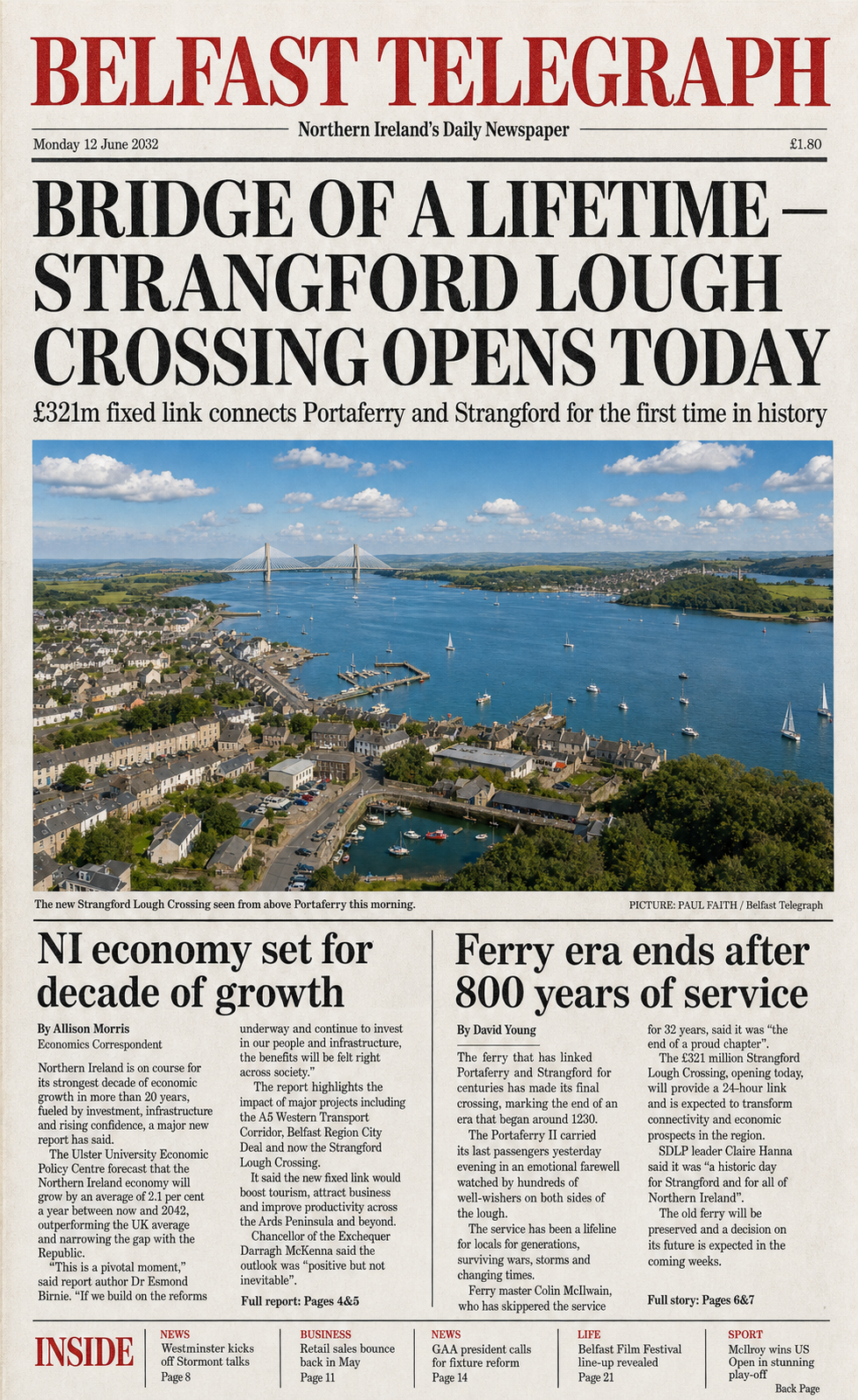
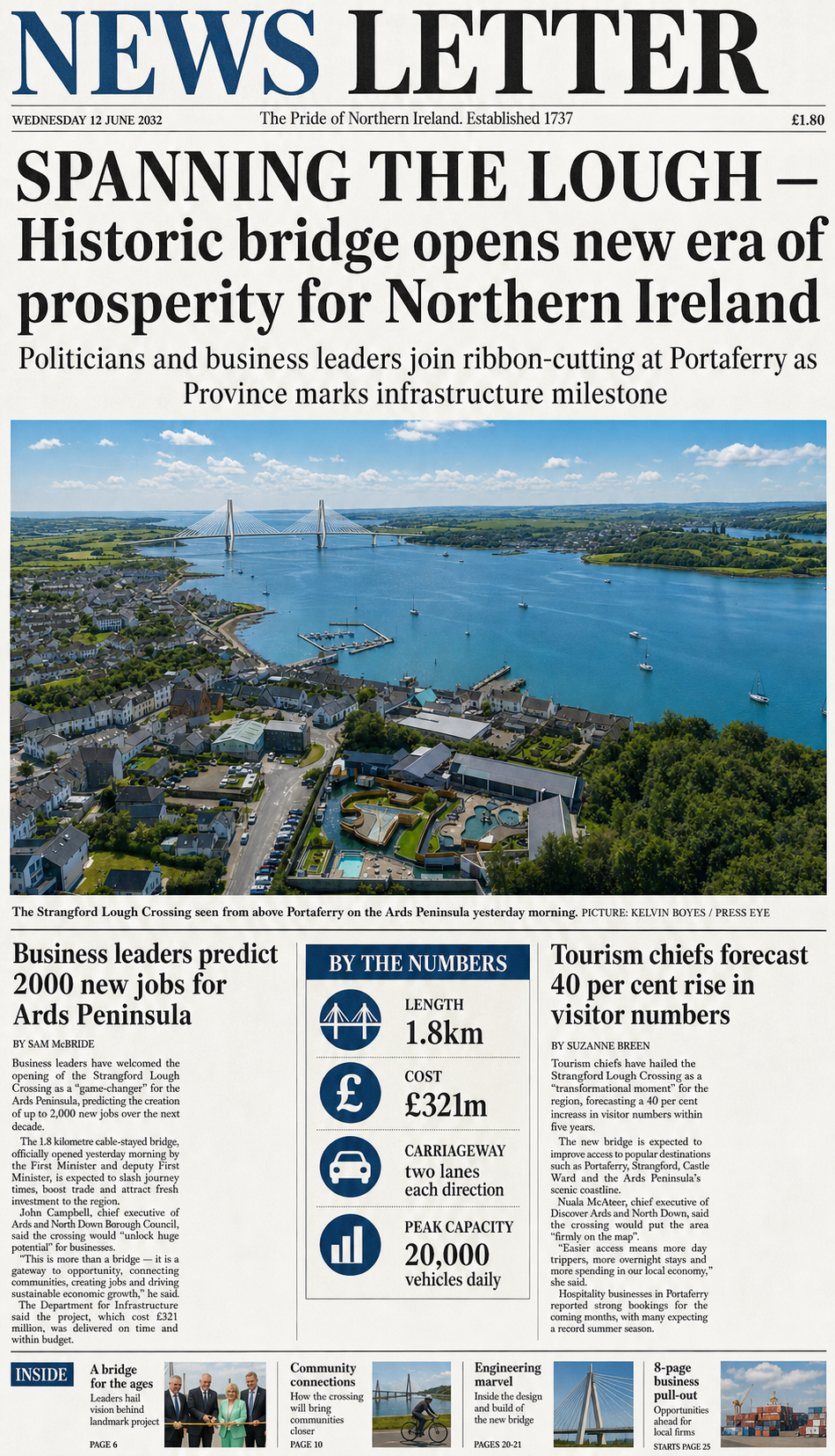
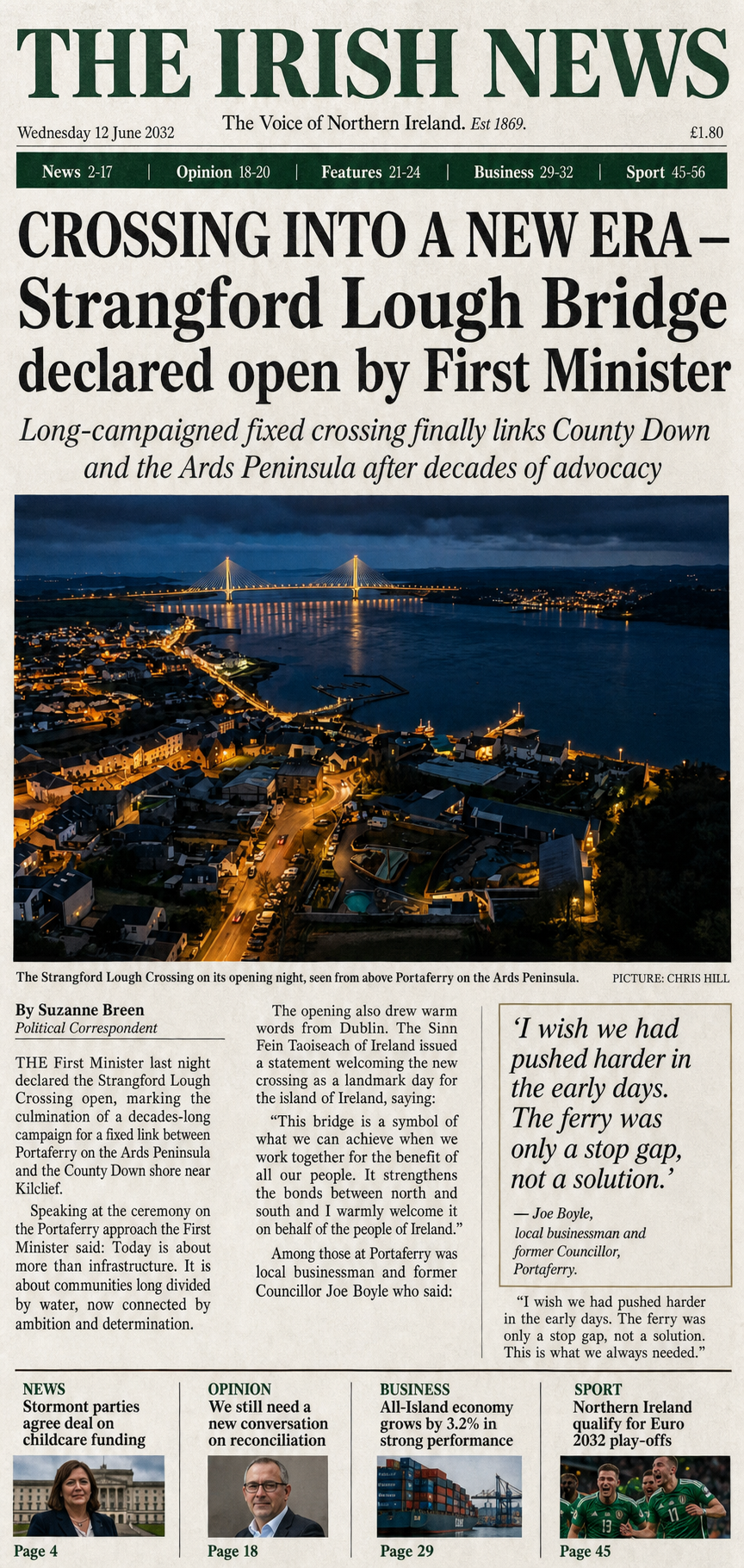
The campaign has used AI-assisted design tools to produce three speculative front pages, each imagined as appearing on Wednesday 12 June 2032. They are presented openly as speculative and illustrative. They are not predictions. They are, however, grounded in the economic and infrastructure logic of comparable projects delivered elsewhere.
The News Letter front page, under the headline ‘Spanning the Lough — Historic Bridge Opens New Era of Prosperity for Northern Ireland’, describes politicians and business leaders joining a ribbon-cutting ceremony at Portaferry as the province marks an infrastructure milestone. It reports that business leaders are predicting the creation of up to 2,000 new jobs over the next decade and that tourism chiefs are forecasting a 40 per cent rise in visitor numbers within five years. It notes the crossing as 1.8 kilometres in length, two lanes in each direction, with a peak capacity of 20,000 vehicles daily.
The Irish News front page, under the headline ‘Crossing Into a New Era — Strangford Lough Bridge Declared Open by First Minister’, describes the opening as the culmination of a decades-long campaign for a fixed link between Portaferry on the Ards Peninsula and the County Down shore near Kilclief. It records that the First Minister spoke at the ceremony, and carries a notable quotation attributed to local businessman and former Councillor Joe Boyle: ‘I wish we had pushed harder in the early days. The ferry was only a stop gap, not a solution. This is what we always needed.’
The Belfast Telegraph front page, under the headline ‘Bridge of a Lifetime — Strangford Lough Crossing Opens Today’, records a cost of £321 million and describes the ferry era as ending after 800 years of service. It notes that the Portaferry II carried its last passengers the previous evening, watched by hundreds of well-wishers on both sides of the lough. It records the SDLP leader as describing it as a historic day for Strangford and for all of Northern Ireland. It further notes that Northern Ireland’s economy is forecast to grow by an average of 2.1 per cent per year between now and 2042, outperforming the UK average.
These are imagined front pages. But the economics, the timescales, and the ambition they reflect are not fanciful. The Cleddau Bridge in Pembrokeshire, Wales, opened in 1975 after a period of planning and construction, and within five years was carrying volumes of traffic well in excess of early projections. The Rose Fitzgerald Kennedy Bridge at New Ross, County Wexford, opened in 2020 to comparable scepticism from those who questioned whether demand justified the investment. Both are now regarded as self-evidently correct infrastructure decisions by the communities they serve.
The Ask Remains Unchanged
The campaign is not asking the Department for Infrastructure to commit to building a bridge. It is asking the Department to commission an independent, Transport Appraisal Guidance-compliant feasibility study — the same instrument that would be applied as a matter of course to any comparable infrastructure question. The cost of doing so is modest. The cost of continuing to refuse is measured in the daily lived experience of the 4,500 residents of the Ards Peninsula south of Portaferry, in the suppressed economic potential of a peninsula that deserves 21st-century connectivity, and in the compounding opportunity cost of delay.
Two councils have passed formal resolutions supporting the feasibility study: Ards and North Down Borough Council and Newry, Mourne and Down District Council. The economic justification that the Department claims does not exist cannot be assessed without the instrument the Department refuses to commission.
That is the circular logic at the heart of the Department’s current position. The campaign respectfully and firmly invites the Minister to resolve it.
Kevin Barry BSc(Hons) MRICS
Campaign Lead, Strangford Lough Crossing Campaign
mail@kevinbarryqs.com | strangfordloughcrossing.org
Portaferry, Co. Down