
- BY Kevin Barry BSc(Hons) MRICS
- POSTED IN Latest News
- WITH 0 COMMENTS
- PERMALINK
- STANDARD POST TYPE
Stormont is overspending on day‑to‑day services it can’t afford, underspending on the investment money it does have, and overrunning by billions on the projects it actually delivers.
That single sentence captures why Northern Ireland’s public finances feel broken – and why “more money from London” on its own will never fix the problem.
The detail….

1. The vicious circle at Stormont
For at least four budget cycles, Stormont has been caught in a damaging pattern.
On one side, departments are planning to spend hundreds of millions more than the budget allows on day‑to‑day services – pay, running costs, plugging holes in health and education. On the other side, the Executive is failing to spend money that has already been approved for capital projects and long‑term investment.
The result is a vicious circle:
- The system staggers from crisis to crisis, relying on late‑in‑the‑year money from London.
- The infrastructure and productivity problems that make services expensive in the first place are left largely untouched.
- When big projects do go ahead, many blow past their original budgets, eroding public trust.
The Treasury’s recent review has focused on the size and cost of the public sector, but the deeper issue is how Northern Ireland uses – and often wastes – the money it already has.
2. Overspending on today: four years of gaps
Let’s start with the overspending.
Independent analysis of Stormont’s budgets shows that resource (day‑to‑day) spending has been running ahead of funding by hundreds of millions each year. The exact numbers move around as in‑year reallocations are made, but the order of magnitude is clear:
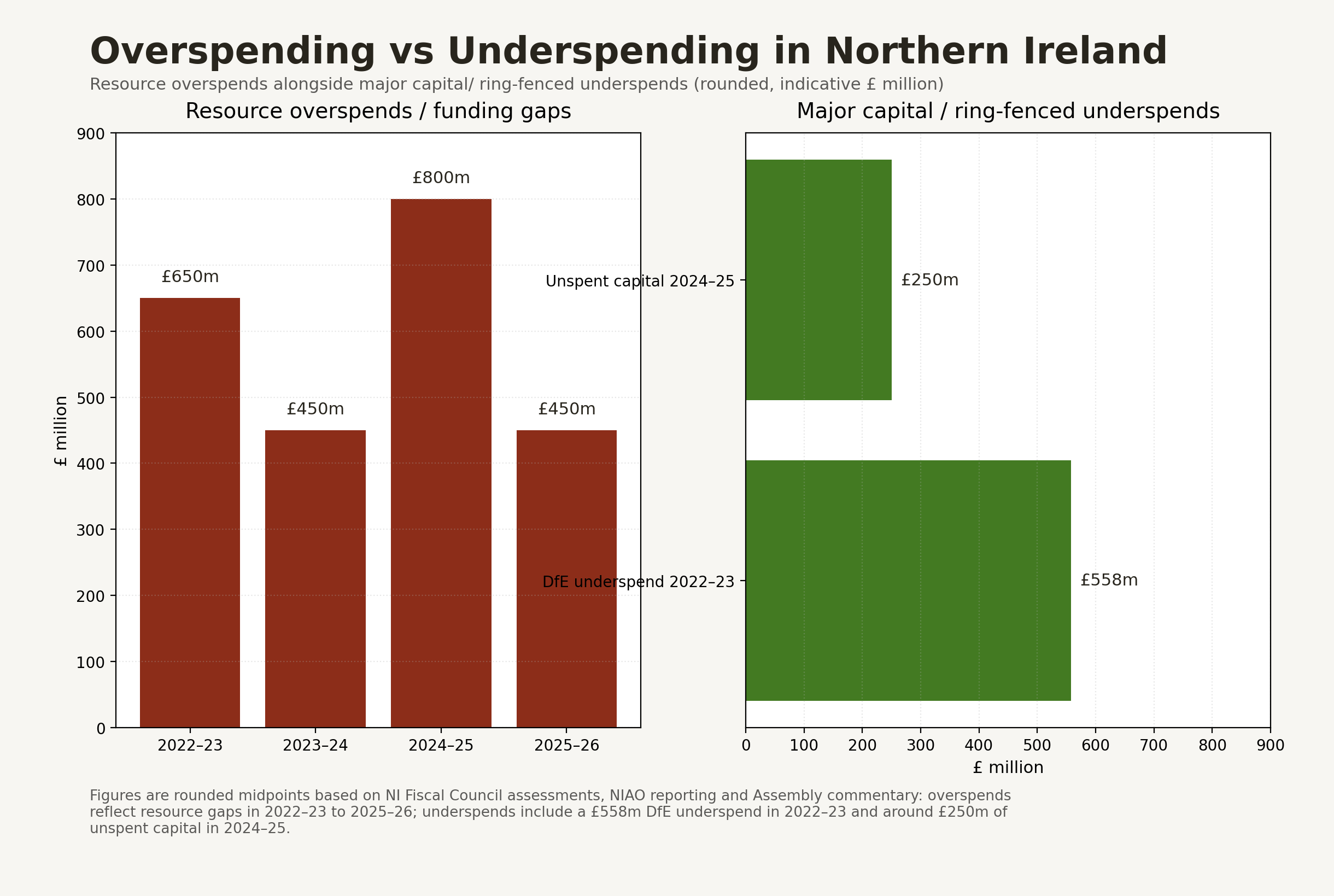
- 2022–23: Departments were on course to overspend by around £650m on resource DEL before emergency measures and UK support were factored in.
- 2023–24: Forecast overspends were in the £400–500m range, again requiring reserve claims and other additions to prevent a formal crash.
- 2024–25: Early projections pointed to a gap of roughly £770–850m, largely closed by about £640m of extra funding generated by the UK Budget and other in‑year changes – but only after months of uncertainty.
- 2025–26: The current year has been propped up by a £400m repayable reserve claim from the Treasury, reflecting a projected overspend in that same ballpark.
Watchdogs are clear about what is driving these gaps: public sector pay deals on top of tight departmental ceilings, especially in health and education. Underpaying staff for a decade was never sustainable; catching up in one or two years without structural reform was always going to blow the budget.
In political shorthand, Stormont has been spending like it’s on a permanent emergency footing, without a credible plan for how that level of day‑to‑day spending will be financed in the medium term.
3. Underspending on tomorrow: capital left on the table
At the very same time as overspending on the resource side, Northern Ireland has been underspending on capital and ring‑fenced budgets – the pots of money that should be used to upgrade infrastructure, modernise services and improve productivity.
Audit work and Assembly commentary have highlighted several uncomfortable facts:
- Over a run of years, ring‑fenced resource budgets (for specific schemes) have repeatedly gone underspent, sometimes by very large margins. In the Department for the Economy alone, cumulative underspends have totalled hundreds of millions of pounds.
- In the 2024–25 monitoring process, opposition MLAs pointed to roughly a quarter of a billion pounds in unspent capital – money that had been allocated for roads, hospitals, schools and other projects but had not been drawn down.
- Some of those underspends relate to flagship schemes: transport corridors, health infrastructure, major regeneration projects. Where projects stall, the capital sits idle, then has to be handed back or reallocated at short notice.
In other words, while the Executive is pleading poverty on day‑to‑day services, it is also failing to use investment money it actually has.
There are reasons, of course: planning delays, procurement disputes, skills shortages in the construction sector, a stop‑start political cycle. But from the public’s perspective, the message is stark: we can’t staff the A&E properly, and we also can’t seem to lay the concrete for the projects we promised.
4. Overruns on what does get built
Even when major projects eventually go ahead, Northern Ireland has a worrying record of taking longer and costing more than planned.
A recent report by the Assembly’s Public Accounts Committee on major capital projects laid out the scale of the problem:
- A portfolio of 70‑plus major capital schemes was originally approved at around £5.7 billion.
- The latest estimates put the total cost closer to £8.7 billion.
- That implies an aggregate overspend of just over £3 billion across the programme.
The Committee’s language was unusually blunt: they described the pattern of overruns as “unacceptable” and “simply unsustainable” in a budget context where the Executive is already relying on emergency support to keep services running.
Taken together, these three strands paint a bleak picture:
- Overspending on day‑to‑day budgets,
- Underspending on available capital, and
- Overspending massively on the capital that is actually delivered.
No wonder the Treasury is asking hard questions.
5. Why this is worse than just “not enough money”
It is tempting – and politically convenient – to treat all of this as a simple funding problem: Westminster doesn’t send enough; Stormont is forced to cut; services deteriorate.
There is truth in the funding argument. Northern Ireland is a relatively poor region with high levels of ill‑health, an ageing population and deep pockets of deprivation. Even after needs‑based adjustments, budgets are tight and rising costs in health and social care would test any devolved administration.
But the overspend/underspend pattern reveals a more uncomfortable reality:
- Stormont is not prioritising within the envelope it actually has.
Core services get overspent in‑year because pay deals and protections are agreed without a realistic view of what must be cut elsewhere. - The Executive is not consistently turning “investment pounds” into actual projects.
Underspends in capital and ring‑fenced budgets mean that approved spending power is literally not being used. - Major projects are not being managed to time and budget.
When you overshoot by £3 billion on a capital programme, that is money that cannot be spent elsewhere, and it reinforces Treasury scepticism.
This is why the phrase “Stormont is overspending on today, underspending on tomorrow, and overspending again on the projects it does deliver” resonates: it captures a management and delivery failure, not just a funding shortfall.
6. How this connects to productivity and everyday life
All of this matters because it feeds directly into Northern Ireland’s long‑standing productivity problem.
Every serious study – from the Northern Ireland Productivity Dashboard to ESRI and NERI reports – agrees on a few basics:
- Output per hour worked in NI is substantially below the UK average, generally in the range of 10–15% under‑performance.
- Compared with the Republic of Ireland, NI’s productivity per worker is roughly 40% lower, even after adjusting for some of the statistical quirks in Irish national accounts.
- Within NI, there are sharp regional gaps between more and less productive local economies.
In that context, under‑investing in infrastructure, digital networks, skills, housing and health capacity is an expensive form of self‑harm. Poor roads, unreliable public transport, clogged hospital systems and creaking utilities all show up as lost hours, higher costs and weaker growth.
A budget system that blows the day‑to‑day allowance and leaves investment money idle is, in effect, choosing to lock in that under‑performance.
7. A different way of spending: “invest to save” in reality
If Stormont wants to break out of this cycle, it needs to change the way it thinks about money. That means:
- Treating capital budgets as the main tool for reducing long‑run costs, not as optional extras that can be cut or left unspent.
- Focusing on projects with clear, well‑evidenced economic and social returns – the ones that genuinely reduce waste and unlock productivity.
- Getting ruthless about project discipline: realistic cost estimates, tighter procurement, and clear accountability when things go over budget.
This is where specific schemes – like the proposed Strangford Lough Crossing – become important test cases. The crossing has been presented not as a vanity project, but as an example of:
- Replacing a recurring subsidy (the Strangford–Portaferry ferry) with a one‑off capital project.
- Eliminating a 75 km detour when the ferry is off, saving time and fuel for workers, businesses and public services.
- Linking two under‑served regions to jobs, services and tourism opportunities, growing the tax base.
You can disagree about the alignment, design or exact numbers. But the principle is clear: spend once, save every year; spend on connectivity and resilience, not on endlessly propping up an inefficient status quo.
8. What needs to change – in plain language
For an informed public in Northern Ireland, a few changes should be non‑negotiable: a pending election is blinding the politicians and thus the UK Government should consider emergency measures to get Northern Ireland on the right track.
- Honest budgets
The Executive should stop publishing plans that only balance by ignoring pay pressures and unmet demand. If the realistic cost of current services is £500m more than the block grant, that gap should be made explicit – and parties should be forced to say how they would close it (taxes, cuts, reform, or more UK funding). - No more “free” underspends
Capital and ring‑fenced underspends should be treated as failures, not quiet windfalls. Every significant underspend ought to trigger an explanation to the Assembly and – where appropriate – changes in how projects are managed. - Tighter control of big projects
Major capital schemes need stronger gatekeeping at the business‑case stage and real consequences for departments that repeatedly overshoot. If a programme is heading for a 50–100% cost overrun, someone should have to explain why it should proceed at all. - Link the money to productivity
Every budget document should include a small set of productivity indicators – output per hour, commuting times, business investment – and show how the capital programme is expected to move them. - Use the public’s anger constructively
People are rightly furious at the idea of domestic water charges or higher rates when money is being left unspent and projects overshoot by billions. That anger can either be channelled into a blanket “no” to everything, or into a sharper demand: “Stop wasting what you have – then talk to us about what more you need.”
9. The real question
The question facing Northern Ireland is not just “Do we need more money?” or “Should we cut the public sector?” It is this:
Can Stormont prove it will use money in a way that moves us out of crisis management and into long‑term value – or will we keep overspending on today, underspending on tomorrow, and overspending again on the things we finally build?
If the answer is the former, there is a strong case for sustained, needs‑based funding and carefully chosen new revenue measures. If it’s the latter, the Treasury’s scepticism – and the public’s frustration – will only grow.