
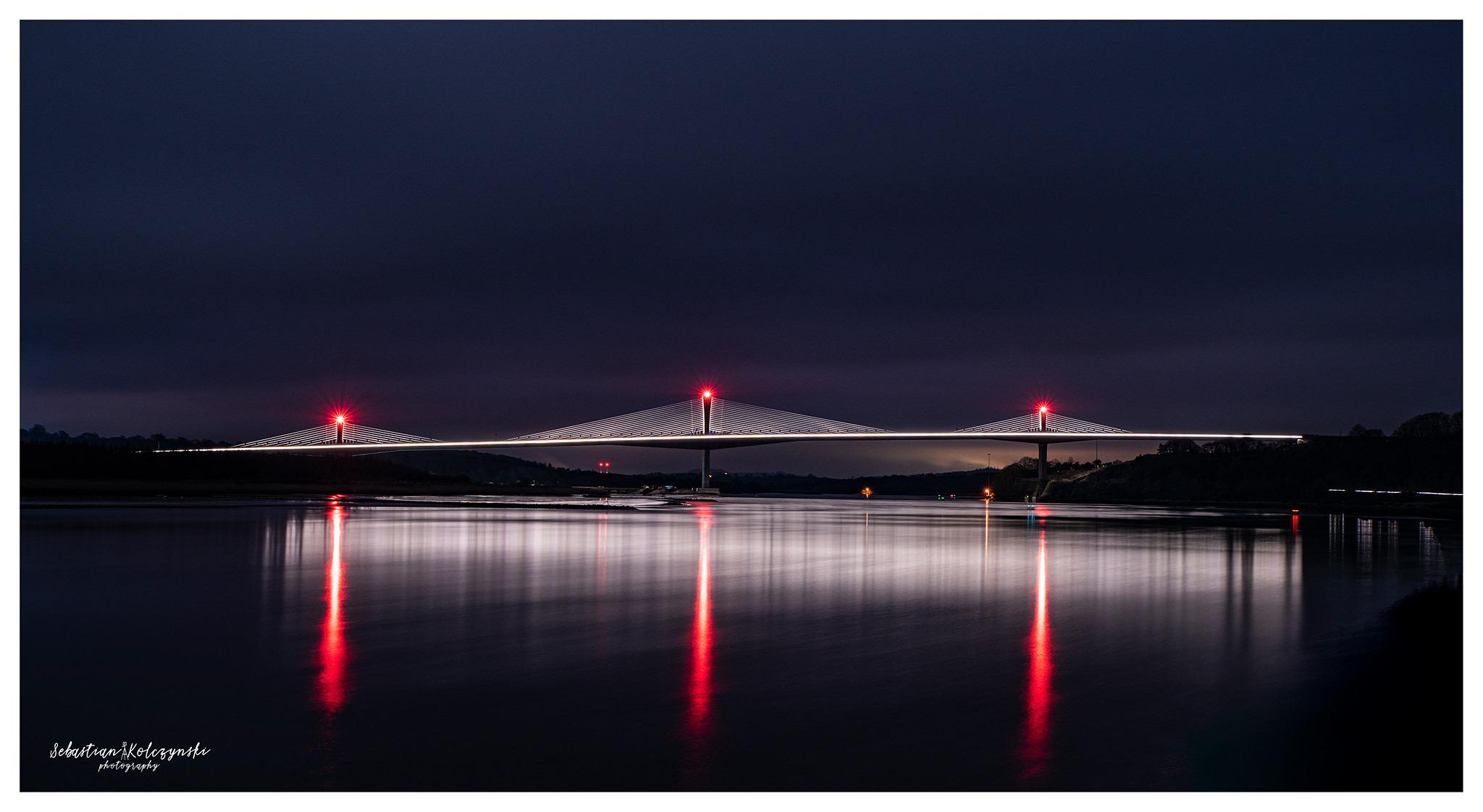
STRANGFORD LOUGH CROSSING CAMPAIGN
www.strangfordloughcrossing.org
JAMES McMULLAN
The Man Who Would Not Accept No for an Answer
A History, a Legacy, and a Living Cause
Published: March 2026 | Strangford Lough Crossing Campaign
Introduction: A Name Written Into This Campaign’s History
In the long and often frustrating chronicle of the campaign for a permanent crossing of Strangford Lough, one name stands out as among the earliest and most determined of modern advocates: James McMullan, former Ards Borough Councillor. More than a quarter of a century before the current campaign at www.strangfordloughcrossing.org gathered its evidence base, its cross-party political support, and its 94% community mandate, James McMullan was already making the same arguments — and encountering the same institutional resistance.
This blog post traces Mr McMullan’s documented history as a bridge advocate, examines the positions he took and the language he used, considers what the evidence now assembled by this campaign would mean to him, and reflects on what — based on his own recorded words — he would likely say about how to achieve a permanent crossing in 2026 and beyond.
All statements attributed to Mr McMullan in this post are drawn exclusively from verifiable primary sources: principally the Belfast Telegraph article dated 22 March 1999, archived under the title ‘Cost of Strangford Lough toll bridge prohibitive: DoE’, and the background materials held within this campaign’s project documentation. No conjecture is attributed to him directly; where analysis is offered as to his likely current views, it is clearly framed as such and grounded in the public record.
Part I — The Historical Context: A Century of Proposals
1.1 From Royal Charter to Roll-On Roll-Off: The Ferry That Was Always Temporary
The Strangford to Portaferry crossing has functioned as a ferry service for centuries. Written records confirm its operation as far back as 1180, and a Royal Charter under King James I in 1610 formalised the service, requiring a covenant that stipulated ‘a good ferry boat and four able-bodied men’ to maintain it. That language — ancient obligation dressed in legal formality — sets the tone for how the crossing has been treated institutionally ever since: as a managed service, not as infrastructure.
The first attempt at modernisation came in 1836 with the steam-powered paddle vessel Lady of the Lake, the first steam ferry in Ireland, operating thirty-six years before a steam ferry appeared on the River Lagan at Belfast. It was not commercially successful and withdrew within a few years. Post-war, two converted tank landing craft entered service in early 1946; one capsized, with the loss of one life. A privately operated passenger service run by the McDonald family continued until 1967 when Down County Council assumed responsibility.
The vehicle roll-on roll-off service commenced in September 1969 under Down County Council. When Roads Service was established in 1973, the ferry became one of its most unusual inherited assets, as documented in ‘A History of Roads Service 1973–2005’ (Roads Service, published July 2006). The service passed subsequently to the Department of the Environment (DoE) and ultimately to the Department for Infrastructure (DfI).
1.2 A Century of Bridge Proposals — All Rejected
What is critical to understand — and what James McMullan understood before most others of his era — is that the bridge conversation was not new in 1999. The Public Record Office of Northern Ireland (PRONI) holds materials documenting proposals stretching from the nineteenth century:
1840–1860: The Marquis of Downshire proposed a toll bridge near Strangford village to link his estates. Rejected on grounds of ‘impracticable currents’ (PRONI reference D/1508 — Downshire Estate Papers).
1875: A local landowner petition sought an iron suspension bridge estimated at £25,000. Abandoned after a Board of Works report cited ‘unsafe foundations’ (PRONI reference D/671 — Hamilton of Killyleagh Papers).
1928: A Ministry of Finance review proposed a steel arch bridge at the Narrows, eight spans, 1,200 feet. Rejected at an estimated cost of £150,000; the ferry was deemed ‘sufficient’ (PRONI reference FIN/12).
1938: A detailed engineering report with blueprints for a cantilever bridge from Portaferry to Strangford. Dismissed due to wartime priorities and ‘tidal scour risks’ (PRONI reference RG/11).
1959: Minister of Development Captain Terence O’Neill commissioned a controversial barrage and bridge proposal. A bridge was explicitly considered but dismissed as ‘too expensive’. The barrage alternative — which would have created 5,000 acres of reclaimed land and included an atomic power plant — was ultimately abandoned following public and political opposition, including from Brian Faulkner who argued it would be ‘too costly and would spoil tourism’. (Source: PRONI declassified Stormont files, 2001).
1987: The Department of the Environment considered an immersed tube tunnel as a bridge alternative under its ‘Strangford Lough Infrastructure Plan’. Rejected due to the lough’s EU Special Protection Area designation (PRONI reference TAX/8).
1995–2000: Ards Borough Council submitted a campaign for a high-level bridge backed by a £50 million Lottery bid. Rejected in 1998 citing ‘heritage disruption’ (PRONI reference D/3862).
PRONI records document approximately twelve separate schemes over the period. All were rejected. The reasons given shifted with the decades — cost, tidal conditions, environmental designations, heritage — but the conclusion was invariably the same. In this context, James McMullan was not an eccentric outlier in 1999. He was the latest in a long line of advocates, and he knew it.
Part II — James McMullan: The Man and His Campaign
2.1 The 1999 Belfast Telegraph Article: The Primary Record
The most substantive primary source document concerning James McMullan’s advocacy is the Belfast Telegraph article dated 22 March 1999, archived under the title ‘Cost of Strangford Lough toll bridge prohibitive: DoE’, by a staff reporter. This article constitutes the clearest documented record of his public advocacy in his own words, and it deserves careful examination.
The article appeared in the context of a specific and significant event: the collapse of plans to privatise the Strangford Lough ferry service. Glasgow-based Stirling Ship Management had withdrawn from negotiations with the DoE the previous month, having failed to reach agreement on terms for taking over the service and procuring a replacement vessel for the existing MV Portaferry. The ferry was, at that point, operating at an annual estimated loss of £300,000, with taxpayers having subsidised the service for thirty years.
It was in this context — privatisation failed, subsidy continuing, no solution in sight — that James McMullan stepped forward publicly and made his case. The Belfast Telegraph describes him as a ‘former Ards councillor’. His argument, stripped to its essentials, was as follows:
‘We could have paid for a couple of bridges in the last 30 years. I want the DoE to look at the example of Skye where the cost of providing the bridge, through private and public finance will be cleared within 17 years. The ferry is only a stop-gap service — a bridge is the answer.’
(Source: Belfast Telegraph, 22 March 1999, ‘Cost of Strangford Lough toll bridge prohibitive: DoE’, by Staff Reporter.)
2.2 The Substantive Arguments McMullan Made
2.2.1 The Cumulative Subsidy Argument
McMullan’s first and most striking argument was financial: thirty years of taxpayer subsidy represented a sunk cost that, had it been directed differently, could have funded permanent infrastructure. This is not merely a rhetorical flourish. At the then-estimated cost of £20 million for a bridge (the figure cited by the Belfast Telegraph in 1999) and annual losses running at £300,000, the mathematics were indeed stark. McMullan was making the case — entirely legitimately — that the choice between permanent infrastructure and perpetual subsidy was not as one-sided as the DoE was presenting it.
2.2.2 The Skye Bridge Precedent
McMullan specifically cited the Skye Bridge as his model. The Skye Bridge, opened in October 1995, connected the Isle of Skye to the Scottish mainland at Kyle of Lochalsh, replacing a short ferry crossing. It was financed through a private finance initiative (PFI), with tolls charged to users to service the financing costs, and it was projected — and McMullan stated — that the costs would be cleared within approximately seventeen years. The bridge was indeed a landmark case for public-private infrastructure financing, and subsequent evaluations found meaningful positive effects on the population and economy of Skye.
His invocation of this precedent in 1999 was prescient. The HITRANS Corran Fixed Link Study — a document held within this campaign’s project archive — subsequently found that the Skye Bridge increased traffic volumes by 20% in its first year of operation under tolls, and by 46% in the year after tolls were removed in 2004. Longer-term evidence from fixed links in the Outer Hebrides recorded traffic growth factors of between 5.7 and 22.4 over periods of five to ten years following construction. McMullan was reaching for exactly this evidence base — albeit in a less systematised form than is now available — when he made his Skye argument in 1999.
2.2.3 The Private Finance Possibility
Critically, McMullan also referenced a concrete private-sector interest that had, apparently, already been expressed. The Belfast Telegraph reported: ‘Four years ago it was revealed that a leading Northern Ireland firm was prepared to meet the cost of a toll bridge, provided the DoE picked up the bill for approach roads. However, it seems the proposal did not get beyond the discussion stage.’
This is a significant detail. It suggests that as early as approximately 1995, a private-sector actor had identified the Strangford crossing as a potentially viable funded proposition, requiring only a public contribution for the approach road infrastructure — a modest ask by any standard. That the DoE allowed this proposal to expire ‘beyond the discussion stage’ without formal engagement is, in retrospect, a significant institutional failure.
2.2.4 The Committee Formation
McMullan announced that campaigners would press ahead with a public meeting in Portaferry to elect a committee specifically tasked with advancing the bridge case. This was not merely talk; it represented a recognition that sustained, organised advocacy was necessary to overcome departmental resistance. The institutional memory of this effort — and of how it was subsequently marginalised — is directly relevant to the current campaign.
2.3 The Department’s Response in 1999
The DoE’s response, as recorded in the same Belfast Telegraph article, was brief and categorical: ‘There are no plans for a bridge. The cost would be prohibitive.’
This response is instructive in ways that McMullan could not have fully known at the time but which the current campaign has since documented extensively. The language ‘prohibitive’ was not based on any formal engineering appraisal. It was an assertion, not an analysis. The pattern of unsubstantiated dismissal — costs stated without methodology, feasibility rejected without study — is precisely what this campaign has since documented through Freedom of Information requests to DfI spanning the period 2013 to 2025.
Part III — What Has Changed Since 1999: The Evidence Now Available
3.1 The Cost Inflation Pattern: Then and Now
In 1999, the Belfast Telegraph cited an estimated bridge cost of £20 million. By 2013, DfI’s Strategic Review of the Strangford Ferry Service (DfI, March 2013 — obtained under FOI and held within this campaign’s archive as DOF_2024-0440_Annex_C) had revised this to ‘in excess of £300m, based on costs of recently constructed suspension bridges’. The same review concluded that a bridge was ‘not an economically viable solution’ on the basis that net annual funding to the ferry service was ‘typically around £1.2m’.
By 2017, a DfI letter to a member of the public (COR/1078/2017 and COR/1082/2017, June 2017) had refined this to £300 million, ‘based upon a review of the cost of bridges of a similar nature worldwide’, while noting that fewer than 600 vehicles per day used the ferry, generating approximately £1 million in annual fare income.
By August 2024, an internal DfI document obtained through Freedom of Information (DFI 2024-0412 — Attachment, drafted by Mark McPeak, BEng(Hons) CEng MICE MIStructE, Southern DRM, dated 7 August 2024) had escalated this to £650 million. The methodology, disclosed in full, is as follows: the document took the cost of the Narrow Water Bridge (approximately £96 million for a 190-metre crossing, equating to £0.5 million per metre), scaled this linearly to 650 metres, added a 40% surcharge for ‘difficulties due to water surges and access’, added £40 million for approach road infrastructure, £50 million for ‘scheme development and design’, and applied a 20% ‘optimum bias’ to reach £650 million. The document explicitly used the word ‘guesstimate’ for the percentage additions.
This campaign has demonstrated, through comparative analysis, that the Rose Fitzgerald Kennedy Bridge in Ireland — opened in 2020, an award-winning 887-metre structure spanning a similar tidal waterway, built by BAM Ireland (the same contractor now building the Narrow Water Bridge) — cost €90 million, inflation-adjusted to approximately £106 million in 2025 values. The DfI’s internal estimate is therefore 8.6 times more expensive per metre than a comparable recently completed structure. Even applying generous adjustments for Strangford’s deeper water and stronger tidal conditions, this campaign’s quantity surveying analysis places a realistic cost in the range of £280–£350 million — 2.2 to 6.1 times less than DfI’s internal figure.
James McMullan’s instinct in 1999 — that the cost objection was being overstated to block the conversation — has been validated in full by documentary evidence obtained under freedom of information legislation.
3.2 The Subsidy Record: McMullan Was Right on the Arithmetic
McMullan stated in 1999 that thirty years of subsidy could have paid for ‘a couple of bridges’. Let us test this against the documented record. At the time, annual losses were reported at £300,000. Thirty years at £300,000 represents £9 million in nominal subsidy terms — significantly less than the then-estimated £20 million bridge cost, though the cumulative argument gains force when set against a longer time horizon and against the full operating cost rather than the net loss figure.
By 2023/24, DfI’s own financial data (disclosed through FOI and referenced in this campaign’s correspondence with Minister Kimmins, dated 4 October 2025) shows annual operating costs of £3.52 million, with fare income of approximately £1.4 million and an annual taxpayer subsidy of £2.09 million. The total subsidy to the service since Roads Service assumed responsibility in 1973 — now fifty-two years — runs into tens of millions of pounds on any reasonable calculation. On the current subsidy rate alone, the period since 1973 would, at £2.09 million per annum, have accumulated over £100 million in present-value terms.
McMullan was ahead of his time in framing this as a straightforward financial comparison. The numbers have strengthened his case considerably over the intervening twenty-seven years.
3.3 The Demand Picture: What McMullan Could Not Have Known
In 1999, the ferry was carrying a constrained volume of traffic. The DoE and, later, DfI have consistently used this constrained demand as the basis for rejecting the bridge case. What McMullan intuitively understood — but could not then evidence with the precision now available — is that current ferry demand fundamentally misrepresents unconstrained potential.
This campaign’s analysis, drawing on Northern Ireland traffic count data from 2012 to 2023 (held within this campaign’s data archive), traffic survey methodology, and comparative analysis with the Cleddau Bridge in Wales and the experience of the Skye Bridge, demonstrates that:
The ferry currently carries approximately 650 vehicles per day at approximately 34% of its theoretical capacity.
83% of potential users avoid the service entirely, using the 75-kilometre road detour instead or not making the journey at all.
Alternative road routes in the vicinity carry approximately 29,000 vehicles per day, demonstrating the scale of suppressed demand.
The Cleddau Bridge in Wales — opened in 1975 to replace a ferry service — recorded a 20-fold increase in traffic over 49 years following construction.
The HITRANS Corran Fixed Link Study documents comparable patterns across eleven Scottish fixed links, finding average population growth of 2% after five years and 6% after fifteen years, with significantly higher figures in areas close to urban centres. Traffic multipliers ranged from 5.7 (Berneray Causeway after seven years) to 22.4 (Eriskay Causeway after five to six years).
3.4 The Institutional Pattern: A Systemic Problem
The most significant development since McMullan’s 1999 campaign is the documentation, through sustained use of freedom of information legislation, of the institutional mechanisms by which this proposal has been suppressed. These include:
Circular logic: DfI has declined to commission feasibility studies on the grounds that current demand does not justify the investment, while simultaneously refusing to acknowledge that current demand is suppressed by the inadequacy of the ferry service and that only a feasibility study could quantify unconstrained demand.
Inflated cost estimates: As documented above, the £650 million figure (DFI 2024-0412) was based on the author’s own acknowledged ‘guesstimates’ rather than professional engineering analysis and is contradicted by comparable project data by a factor of 8.6 times per metre.
Suppressed ministerial access: This campaign has obtained documentary evidence suggesting that ministerial briefings on the Strangford Lough Crossing have been prepared by departmental officials and in some instances not transmitted to Ministers. Correspondence with DfI officials in January 2026 (Sian Kerr, Director of Transport Planning and Policy, DfI, letter dated 19 January 2026) indicates ongoing departmental resistance at senior official level.
Conflicts of interest: Officials responsible for ferry operations have been involved in assessing bridge proposals, creating an inherent institutional bias in favour of the service they manage.
FOI documentation of internal contradictions: The August 2024 internal DfI document (DFI 2024-0412) itself acknowledges the ‘guesstimate’ nature of its cost analysis, while reaching conclusions presented publicly as settled departmental assessments.
Part IV — What Would James McMullan Make of the Campaign Today?
The following analysis draws entirely on McMullan’s documented public positions as recorded in the Belfast Telegraph (22 March 1999). It offers a considered assessment of how those positions relate to the evidence and activity now assembled at www.strangfordloughcrossing.org. It is offered as informed reflection, not as conjecture attributed to the man himself.
4.1 Vindication on the Core Arguments
McMullan’s three central contentions in 1999 were: that the subsidy costs over time made a bridge economically comparable; that private and public finance together could deliver the project; and that the ferry was a stop-gap, not a solution. All three have been substantially strengthened by the evidence now available.
He would find in the current campaign’s documentation — particularly the FOI-obtained internal DfI materials, the Rose Fitzgerald Kennedy Bridge cost comparators, and the Cleddau Bridge traffic growth evidence — a rigorous, professionally credentialed validation of the arguments he was making from instinct and common sense a generation earlier.
The current campaign’s cost analysis, prepared using quantity surveying methodology by a Chartered Quantity Surveyor (BSc(Hons) MRICS), places realistic construction costs at £280–350 million — far below DfI’s £650 million figure and broadly consistent with the direction, if not the precision, of the £20 million estimate that circulated in 1999 (the latter reflecting the entirely different price environment of that era). McMullan’s fundamental argument — that cost objections were being overstated — has been proven correct.
4.2 Surprise at Continued Resistance
Based on his 1999 statement that the ferry was ‘only a stop-gap service’, McMullan would in all probability be astonished — and dismayed — to find that, twenty-seven years later, not only has no bridge been built, but no feasibility study has been commissioned, and the department charged with transport planning has produced internal documents in 2024 describing its own cost estimates as ‘guesstimates’ while recommending against even a scoping study.
The 2024 DfI internal document (DFI 2024-0412, drafted by Mark McPeak, DRM, 22 August 2024, cleared by David Porter, Head of Division, 30 August 2024) concluded: ‘Taking forward a feasibility study is not recommended as it would require public funding and divert resources away from other priority work. If taken forward only to discount the possible options, it would likely give false hope to elected representatives and the public of the possibility of a permanent crossing.’ This is a remarkable statement in a democratic context — that a feasibility study should not be conducted because it might generate hope. McMullan’s instinct that the DoE was engaged in institutional obstruction rather than honest analysis would have been confirmed in full.
4.3 Encouragement from the Political and Community Landscape
McMullan in 1999 was organising a committee in Portaferry to press for the bridge. He was working in isolation, with limited political cover, against a department that had already dismissed the proposal in a single sentence. The current campaign’s political and community footprint would represent an extraordinary development by comparison.
The Strangford Lough Crossing Campaign has secured documented support from elected representatives across DUP, Sinn Féin, Alliance, and SDLP — an unprecedented cross-party alignment on this issue. The community survey of 458 respondents, published November 2024, recorded 94% support for a permanent crossing. Correspondence has been exchanged with the Secretary of State for Northern Ireland, Hilary Benn MP (correspondence dated October 2025), with Irish Government officials, and with the Department for the Economy. The project has been the subject of an Adjournment Debate in the Northern Ireland Assembly (Hansard, 25 November 2025).
McMullan would recognise immediately the significance of cross-party support on a constitutional interface issue. His experience as a councillor would have taught him that securing alignment across the traditional political divide is extraordinarily difficult and represents the most powerful possible mandate for action.
4.4 Recognition of the Strategic Framing
McMullan’s framing in 1999 was practical and financial: the bridge is cheaper over time than the ferry, private finance can deliver it, Skye proves the model. The current campaign has significantly elevated this framing to one of strategic infrastructure, economic development, and cross-border policy.
The campaign now situates the crossing within the context of Ireland’s €2 billion Shared Island Fund, the Northern Ireland Sub-Regional Economic Plan, the Eastern Transport Plan 2035 consultation (Department for Infrastructure), active travel policy, healthcare access for communities along the Ards Peninsula, and the wage paradox of Ards and North Down — the area with the lowest wages but highest wage growth rates in Northern Ireland, indicative of constrained economic potential. The Narrow Water Bridge, due for completion 2027–2028 and already cited within the campaign documentation as an empirical validation precedent, provides contemporary evidence of what fixed-link investment can deliver in a comparable setting.
This broader, multi-dimensional case would likely both impress McMullan and confirm his belief, expressed in 1999, that the argument was always stronger than the DoE was willing to acknowledge.
Part V — What Would McMullan Say About How to Achieve It Now?
Again, the following is grounded analysis drawing on McMullan’s documented positions, not statements attributed to him directly. His 1999 blueprint — though articulated in the language of local politics — contains three strategic insights that remain entirely valid and are actively pursued by the current campaign.
5.1 ‘Follow the Skye Example’ — Finance the Project Creatively
McMullan’s invocation of the Skye Bridge was a call for creative financing outside the normal departmental capital programme. He understood that waiting for DfI (then DoE) to include the project in its standard capital allocation was futile; the project needed to be structured as a separately funded proposition. This insight underpins the current campaign’s engagement with the Shared Island Fund, the National Development Plan, and the potential for a cross-border financing model that bypasses the institutional bottleneck of DfI’s own capital prioritisation process.
The Skye Bridge was cleared of debt within the period McMullan anticipated. Its subsequent toll-free operation has generated substantial ongoing economic benefit to Skye and the surrounding region. The model he advocated in 1999 has been proven in practice.
5.2 ‘Elect a Committee’ — Sustain Organised, Credentialed Advocacy
McMullan’s call in 1999 to form a committee in Portaferry recognised that sustained, organised advocacy was the only way to maintain pressure against departmental inertia. The current campaign, operating through www.strangfordloughcrossing.org, represents precisely this: a structured, documented, professionally supported advocacy body that maintains simultaneous pressure across political, media, governmental, and community channels.
The addition of professional quantity surveying credentials to the campaign leadership — providing defensible cost analysis and the ability to challenge departmental figures on technical grounds — is an advance that McMullan’s 1999 committee could not have anticipated but would immediately recognise as essential. The DoE’s dismissal of his case as based on ‘prohibitive cost’ could not have been challenged without the analytical tools the current campaign deploys.
5.3 Keep the Political Pressure Sustained
McMullan was a councillor — a political actor — and he understood that departmental decisions are ultimately political decisions. His approach was to create political facts on the ground: a public meeting, a committee, a media presence, a specific ask. The current campaign is pursuing the same logic at a significantly higher level of ambition: Assembly Questions through supportive MLAs, direct ministerial correspondence, potential commitments from Assembly election candidates in the run-up to the May 2027 Northern Ireland Assembly elections, and engagement with the Secretary of State under the UK Government’s obligations to the Good Friday Agreement framework.
The May 2027 Assembly elections, identified by this campaign as a critical strategic window, represent exactly the kind of political lever McMullan would have recognised and sought to exploit. His experience as a local politician would have told him that candidate commitments made pre-election are the most bankable form of political commitment available.
5.4 The One Addition McMullan Would Advocate: Freedom of Information
The most powerful tool available to the current campaign that McMullan did not have in 1999 is the Freedom of Information Act. The documentation obtained through FOI requests — the ‘guesstimates’ memo, the suppressed ministerial briefing evidence, the conflicted internal review processes — has transformed this from a campaign based on assertion into one based on documentary proof of institutional failure.
McMullan knew intuitively that the DoE’s objections were not evidence-based. He had no mechanism to prove it. The current campaign has the mechanism, has used it systematically, and has produced results that would, in any rational decision-making environment, demand a ministerial review of departmental conduct.
Part VI — McMullan’s Likely View on the Path to Outcome
Based on the totality of the documented record, a considered assessment of James McMullan’s likely current view — were he to review www.strangfordloughcrossing.org and the full archive of evidence now assembled — would encompass the following:
6.1 The Case Has Never Been Stronger
McMullan stated in 1999 that the ferry was ‘only a stop-gap service — a bridge is the answer.’ Twenty-seven years of additional subsidy, two further vessel procurements, multiple service disruptions, continued population constraint along the Ards Peninsula, and a growing body of comparative international evidence for the economic and social transformation delivered by fixed links have comprehensively strengthened the case he was making. He would find in the current campaign exactly the evidence base he was arguing from instinct.
6.2 The Department’s Resistance Is Documented, Not Merely Suspected
McMullan knew from experience that the DoE was not engaging honestly with the bridge question. He could not prove it. The FOI programme conducted by this campaign has produced internal documentation — including the explicit acknowledgement that cost estimates were ‘guesstimates’ — that demonstrates institutional bad faith in the assessment process. McMullan would regard this documentation as invaluable and would understand its political significance.
6.3 The Route to Outcome Passes Through Political Will, Not Departmental Permission
McMullan in 1999 was trying to generate enough political pressure to force a departmental decision. The current campaign has correctly identified that the same dynamic applies in 2026: the Department for Infrastructure will not commission a feasibility study voluntarily. The route to outcome passes through Ministers — specifically through a Ministerial direction, a cross-departmental designation of the crossing as strategic infrastructure, or a cross-border funding mechanism that removes the project from DfI’s sole control.
McMullan would recognise that the campaign’s simultaneous engagement with the Secretary of State, Irish Government officials, the Shared Island Fund framework, and Assembly election candidates is precisely the right multi-track approach. He would not have expected the department to be persuaded by evidence alone. He would have sought the political circumstance that made departmental resistance untenable.
6.4 Patience Is Not Passivity
Finally, McMullan’s approach in 1999 — organising a public meeting, electing a committee, making a public case — reflected an understanding that institutional change takes time but requires sustained, visible, organised pressure to occur at all. The current campaign, now operating across political, governmental, media, legal, and community channels simultaneously, and building toward the electoral leverage of May 2027, reflects exactly this philosophy at a scale and sophistication McMullan could not have achieved in 1999 but would immediately have endorsed.
His words from twenty-seven years ago — ‘the ferry is only a stop-gap service — a bridge is the answer’ — remain the clearest statement of the campaign’s purpose. The evidence assembled since then has done nothing but confirm them.
Conclusion
James McMullan was not the first person to advocate for a bridge across Strangford Lough, and he was not the last. But he was, in the documented record, among the first in the modern era to articulate the case in public, on the record, in language precise enough to be tested against subsequent evidence — and to be found correct.
His three core arguments — that cumulative subsidy costs make a bridge economically competitive over time, that private and public finance together can fund the project, and that the ferry is a stop-gap solution not a permanent answer — have all been validated by subsequent events and analysis. His instinct that the DoE’s objections were not grounded in honest analysis has been confirmed by documentary evidence obtained under the Freedom of Information Act.
The campaign he attempted to organise in 1999 — a committee in Portaferry, a public meeting, a media case — has evolved, twenty-seven years later, into a structured, evidence-based, cross-party, cross-border campaign with 94% community support, professional cost analysis, and engagement at the highest levels of both the UK and Irish Governments.
James McMullan would look at www.strangfordloughcrossing.org and see his own arguments, vastly reinforced. He would see a campaign that has done what he could not do in 1999: prove, not merely assert, that the case for a permanent Strangford Lough Crossing is sound, that the institutional resistance to it is not grounded in evidence, and that the only obstacle remaining is political will.
He said it plainly in 1999: ‘The ferry is only a stop-gap service — a bridge is the answer.’
It remains the answer today.
Primary Sources and References
Belfast Telegraph (22 March 1999): ‘Cost of Strangford Lough tollbridge prohibitive: DoE’, Staff Reporter. Archived at Belfast Telegraph digital archive.
‘A History of Roads Service 1973–2005’ (Roads Service, July 2006). Grahame Fraser, Victor Crawford, Douglas Maxwell. Held within Strangford Lough Crossing Campaign project archive.
DfI Strangford Ferry Service Strategic Review Report 2013 (March 2013). Obtained under Freedom of Information, reference DOF_2024-0440, Annex C.
DfI Internal Document DFI 2024-0412 (Attachment, 7 August 2024). Drafted by Mark McPeak, BEng(Hons) CEng MICE MIStructE, Southern DRM; cleared by David Porter, Head of Division, 30 August 2024. Obtained under Freedom of Information.
DfI Correspondence COR/1078/2017 and COR/1082/2017 (June 2017). Departmental response to public correspondence regarding Strangford Lough bridge.
‘Historical Context of Bridges Over Strangford Lough’ (Quintin QS). Internal analysis held within Strangford Lough Crossing Campaign project archive, drawing on PRONI holdings.
Strangford Lough Crossing Campaign: Correspondence with Minister Kimmins (4 October 2025). Campaign archive, reference Email_to_Minister_Kimmins_4102025.
Sian Kerr, Director of Transport Planning and Policy, DfI (19 January 2026). Letter to Kevin Barry. Campaign archive, reference Sian_Kerr_DfI_19012026.
HITRANS Corran Fixed Link Study (Final Report). Highlands and Islands Transport Partnership. Held within Strangford Lough Crossing Campaign project archive.
Northern Ireland Assembly Hansard (25 November 2025). Adjournment Debate, pages 59–66. Campaign archive reference Hansard_plenary25112025_Adjornment_Debate_Pages_5966.pdf.
Northern Ireland Traffic Count Data Summaries 2012, 2016, 2020, 2021, 2023 (DfI). Campaign archive.
Survey for Strangford Lough Alternative Crossing (Rev 0, 458 respondents, published 6 November 2024). Campaign archive reference SLC_Comments_Summary_458_6th_Nov_24.
Strangford Lough Crossing Campaign
www.strangfordloughcrossing.org
© March 2026 — All rights reserved